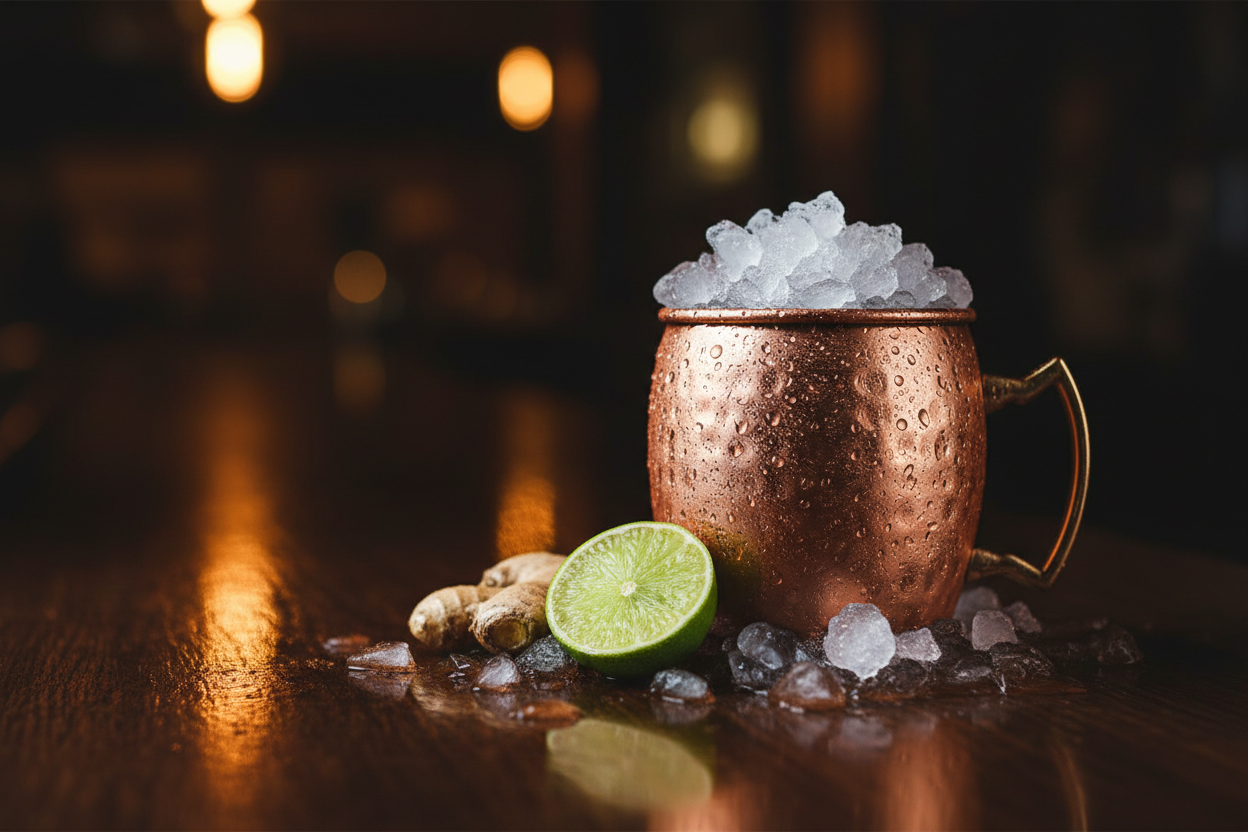
Why is the glass at Moscow Mule made of copper?
The copper mug used for Moscow Mules keeps drinks cold, enhances the aromas, and truly transforms the tasting experience. Limonadier explains why.
⚡ Key points to remember
- The copper container was born in 1941 from a commercial accident: three stocks to get rid of, a drink created in the process.
- Metal conducts heat 400 times better than glass. The beverage stays ice-cold much longer.
- The handle is not decorative: it prevents the heat from your hand from rising into the liquid.
- Pure metal = health risk with acidic liquids. Food-grade plated steel = the right choice.
- A well-maintained steel model will last for years. It also makes a memorable gift.
Where did the copper mug from the Moscow Mule come from?
The copper-colored glass of the Moscow Mule originated in 1941 in Los Angeles, from the meeting of three people, each with unsold stock to get rid of: Smirnoff vodka, homemade ginger beer, and unsold metal cups. The glass has remained, and with it, a visual identity instantly recognizable among all cocktails.
The Cock'n'Bull, Sunset Strip, Hollywood, 1941. John G. Martin imports Smirnoff vodka. He struggles to convince Americans—at the time, they don't drink it. Jack Morgan, the bar owner, is drowning in his stock of homemade ginger beer that he can't sell. A Russian immigrant who's there that evening has been trying to sell her handcrafted cups for weeks. They combine their three problems: vodka, ginger beer, lime, and a cold metal container.
To promote the drink, they photographed each customer who drank it with a Polaroid camera—a still rare invention at the time. The photos circulated from bar to bar on the West Coast. The glass became as famous as the recipe. In the 1950s, it was the most ordered cocktail in the United States. During the Cold War, it was renamed the Smirnoff Mule. The glass, however, remained unchanged.

Why does copper keep the cocktail colder?
It conducts heat 400 times better than glass (400 W/m·K versus 1 W/m·K). Upon contact with ice cubes, the cup cools almost instantly and maintains this temperature until the last sip. The handle prevents the heat from your hand from rising into the liquid.
Here's what happens. You pour the liquid over crushed ice into the cup. The metal immediately absorbs the temperature of the contents. Condensation forms on the outside—a sign that the wall is cold, not that the contents are warming up. In an ordinary container, the wall remains at room temperature and allows heat from the air to penetrate. The liquid warms up in a few minutes.
Carbonation follows the same principle. At lower temperatures, the CO₂ bubbles in ginger beer escape less quickly. The fizz lasts. In an ordinary container like a margarita glass , it dissipates rapidly. In a tumbler taken from the refrigerator 15 minutes before serving, it lasts twice as long.
Comparison of materials
| Container | Thermal conductivity | Tasting results |
|---|---|---|
| Pure metal | 400 W/m·K | Immediate cooling, a distinct sensation on the lips |
| Exterior-plated steel | 15 W/m·K | Effective freshness, the right choice for everyday use |
| Highball glass | 1 W/m·K | Heats up quickly, bubbles dissipate rapidly |
| Plastic cup | 0.2 W/m·K | Warm in 5 minutes |

Does copper really change the taste of a Moscow Mule?
Yes, but not for the reason you might think. It's not the metal that amplifies the aromas. It's the low temperature—the one discussed in the previous section—that prevents the volatile compounds in the ginger and lime from evaporating. They remain in the liquid. The taste is cleaner, more precise.
Ginger contains terpene compounds—zingiberene and bisabolene—that evaporate as soon as the temperature rises. In a chilled container, they remain in the liquid until the last sip. This is the same reason why champagne served too warm loses its aromatic freshness.
There's also a direct sensory effect. Holding this mug in your hand sends a cold signal to the brain, which associates it with the contents. The coldness seems more intense, the beverage lighter. This isn't just suggestion: a very cold beer is objectively better than one served in a container fresh from the dishwasher, which is still hot. The same logic applies here.
Some sources suggest a reaction between the metal and citric acid that enhances the ginger flavor. In a glass with a steel inner wall—where only the inside touches the liquid—this effect is negligible. What really matters is the temperature. You'll never be able to replicate this effect in a whiskey glass because they're not the same materials.

Pure copper or copper-plated stainless steel: which to choose?
Plated stainless steel. It's the only sensible choice for everyday use. Pure metal releases ions when it comes into contact with an acidic liquid. Repeated exposure poses a real health risk. Steel ensures neutral contact with food; the exterior plating preserves its appearance.
In 2017, the Iowa Alcoholic Beverages Division warned American bars against using pure metal containers to serve acidic cocktails. This drink falls squarely into that category: its pH ranges from 3.5 to 4, between lime and ginger beer. At this acidity level, uncoated metal releases ions. Regular consumption can lead to nausea and digestive problems.
The solution is simple and now standard in establishments: a container with a food-grade stainless steel interior (18/8 or 18/10) and a plated exterior, either smooth or hammered. This preserves freshness, a golden patina, and a pleasant grip.

Which mug should I choose as a gift or to equip a bar?
For home use, a hammered-finish model with a capacity between 40 and 55 cl is sufficient. For a bar or restaurant, aim for at least 55 cl with a reinforced handle. This capacity leaves room for crushed ice without spillage when serving.
🎁 Give it as a gift
This container is a gift that works. Instantly recognizable, useful from the very first use, and durable if cared for. A set with two designs and two matching straws always makes a great impression. You can even slip in a printed recipe. It's also a good option for a corporate gift or cocktail party.
According to the profile:
- Amateur at home → hammered timpani, single or in pairs, 45–50 cl
- Bartender or mixology enthusiast → complete set with shaker, jigger and 55cl tumblers
- Bar or restaurant → set of 6 or 12 identical models, uniform finish, reinforced handle

Frequently Asked Questions
Can a regular glass be used instead?
Yes. A highball or tumbler works. But the liquid heats up faster, the bubbles dissipate sooner, and the warming sensation on the lips disappears. The flavor is less precise.
How do you maintain this type of container?
Hand wash only: warm water, mild detergent, dry immediately with a soft cloth. Never put in the dishwasher — even a standard model will be damaged after the first few uses.
Is pure metal dangerous with acidic liquids?
With repeated use, yes. Pure metal reacts with acidity and releases ions. In high doses: nausea, digestive problems. The Iowa Alcoholic Beverages Division alerted American bars as early as 2017. A model with an inner steel wall eliminates this risk.
What is the ideal capacity?
Between 45 and 55 cl. Enough room for crushed ice and 15 cl of beverage. For a bar, 55 cl is the standard: more generous serving, less splashing.
Does the choice of container really affect the tasting experience?
For iced and sparkling drinks, yes: they maintain their freshness, have stable bubbles, and feel good in the hand. This cocktail, the Mojito, and the gin and tonic fall into this category. Wine or hot drinks follow different rules.
📖 Articles to explore further
Benjamin Fournier — Sommelier-Consultant
Graduate of the University of Wine in Suze-la-Rousse · 5+ years of experience in wineries · Founder of Limonadier.co
Key takeaways
This glass isn't just another aesthetic choice. It keeps the wine fresh, stabilizes the bubbles, and retains the ginger aromas in the liquid. Choose a model with a stainless steel interior and chill it in the refrigerator for 15 minutes before serving. You'll taste the difference from the very first sip.
Article updated on 2026-03-14


Leave a comment
This site is protected by hCaptcha and the hCaptcha Privacy Policy and Terms of Service apply.