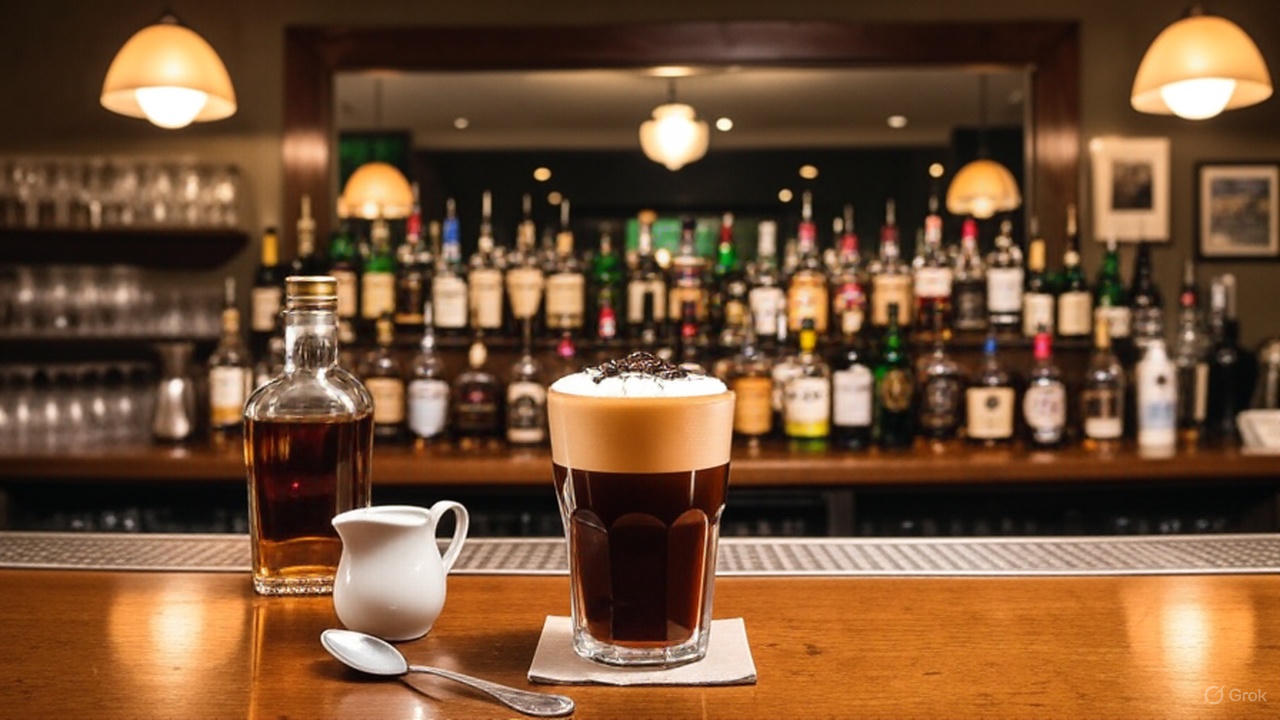
What exactly constitutes preparing a perfect Irish Coffee in a glass?

Our online shop , Limonadier, tells you all about it: This cocktail, which originated in Ireland, was created in 1943 by Joe Sheridan during a layover at Foynes Airport in Ireland. This drink is relatively complex to produce; its design relies on the difference in density between each layer. This is what allows it to be layered without mixing.
According to a 2024 study by the Barista Academy, 78% of failures when preparing this Irish cocktail are due to three critical points: insufficient temperature, incorrect order of ingredients, and improper pouring technique.
Reference data:
Case in point: One of the most famous bars when it comes to this cocktail is the Buena Vista in San Francisco. They sometimes serve up to 2,000 Irish Coffees daily, a practice they've maintained since opening in 1952. Their secret: Preheat their glasses to 65°C, their coffee to 78°C, then pour the cream over the back of a knife for 25 seconds.
| Layer | Density (g/cm³) | Temperature | Final position |
|---|---|---|---|
| Sweet base (coffee + dissolved sugar) | 1.05-1.08 | 75-82°C | Bottom of the glass |
| Whisky 40° | 0.92-0.95 | Room temperature | On a sweet base |
| Strong black coffee | 1.01-1.02 | 75-80°C | Main body |
| Whole liquid cream 30-35% fat | 0.98-1.00 | Room temperature | Floating surface |
But how does the 4-layer lamination work?
Process :

Step 1: Formation of the dense sugar base
You'll need 5-7 grams for 200ml of coffee. Stir it into the hot coffee (75°C). This will thicken and thicken the coffee, preventing the top layer from sinking to the bottom. Our tip: as soon as you add the sugar, stir for a good 15 seconds to ensure it's well mixed.
2: Natural flotation of whisky
To make this layer float, you need to use Irish whiskeys, which generally contain 40% alcohol. This gives them a lower density than the layer you just created. In other words, your current layer will be less dense, so it won't sink into it but will remain positioned on top.
Our tip is to pour the whiskies very gently for 15-20 seconds for a quantity of 40ml.

3: Construction of the main body at the cafe
Let's continue with another layer of coffee, which you'll place on top of the previous layer. This time, without sugar. This layer won't create a clean separation, but rather a gradient. Because the unsweetened coffee is lighter than the other two layers, it will settle between them.
4: Controlled Flotation
Now for the most important part: adding the cream. Be careful, it shouldn't be whipped. You're starting to understand the principle: this layer is the lightest, so it will float. This ingredient isn't chosen randomly; its natural viscosity helps create a clean separation without penetrating the other layers. Our tip: It should be at room temperature, not too cold. Then, add it very slowly.
Success factors:
- Take your time: With each pour, take your time. It must be done gently to prevent the spill from being too forceful and soaking into the layer below. You can use the back of a fork or knife to slow the fall.
- Usage : The use of liquid whole cream which contains 30-35% fat allows for better flotation and good viscosity.
Why is preheating the glass mandatory for Irish Coffee?
As a casual drinker, you might wonder about the point of preheating a glass. When you pour, your drink is very hot, but your glass is cold, causing thermal shock. This can lead to breakage and micro-cracks, potentially resulting in a burn. So how do you preheat your glass?
Recommended preheating methods:
Method 1 - Hot tap water (recommended for beginners): The simplest method is to turn on your tap, set it to very hot, and then simply leave your glass underneath for 3 minutes. Dry it with a cloth.
Method 4 - Steam espresso machine (professional): Wondering how a professional does it? Their coffee machines have a steam wand. They simply activate it and place the container underneath to have a hot cup in 10 seconds.
How to prepare an Irish Coffee step by step?

Detailed protocol with precise timing:
Step 1: Preparing and measuring the ingredients (2 minutes)
Ingredients required for 1 Irish Coffee (240ml):
- 5-7g of brown or white sugar (1 heaped teaspoon)
- 40-50ml of Irish whiskey (Jameson, Bushmills, or Tullamore Dew)
- 150-170ml of coffee, temperature 78-82°C at the time of preparation
- 30-40ml of whole cream (30-35% fat) at room temperature
Materials needed: 240-280ml Irish Coffee glass (tulip-shaped stem), spoon, thermometer, timer
Step 2: Preheating of the glass is mandatory (3 minutes concurrently)
As we just saw, if you're not a professional, the best way is to run hot water over the glass for 3 minutes so the heat spreads evenly to the inside of the container. The water should be 50°C (122°F). Our tip: do this step while your coffee is brewing to save time. Remember to dry your glass thoroughly so as not to dilute your cocktail.
Step 3: Dissolve the sugar in the coffee base (30 seconds)
Empty and dry the preheated glass. Pour in 15-20 ml of hot coffee (75-80°C). Then immediately add 5-7 g of sugar. Stir well for 10-15 seconds until the sugar is no longer visible to the naked eye. This dense sugar base (density 1.05-1.08) is the foundation for all the layers.
Step 4: Adding the Irish whiskey (20 seconds)
Now it's time to gently add the Irish whiskey. Remember to take it out beforehand so it's at room temperature. Simply pour it slowly for 15 seconds until you see a thin amber layer about 0.5 cm thick.
Our tip if you're really looking for aromas: you should use a classic Irish whiskey (Jameson, Bushmills, Tullamore Dew) rather than overly complex whiskies, which are best enjoyed neat in a tulip glass . A bottle costing around €25 will already give you a very good quality one.
Step 5: Pouring the main body of coffee (30 seconds)
For the third layer, simply pour in the remaining hot coffee. Do this gently; you can pour it down the side of the container so it flows smoothly over the second layer. Fill it to 2-3 cm.
Pouring technique: As with filling a beer mug, you can slightly tilt your cup at 20°. This will allow the beer to pour gently.
Step 6: Floating (30 seconds)
Everyone knows this little trick for cocktails, but we'll share it again: Use a heaped tablespoon about 1-2 cm above the surface of your drink, then pour your mixture onto the back of the spoon. This technique softens the impact and allows you to gently deposit the cream layer on top of the coffee.
| Time elapsed | Action | Target temperature | Validation |
|---|---|---|---|
| T+0 min | Start coffee + preheat glass | Coffee 78-82°C / Glass of water 50-60°C | Coffee brewing / Glass under hot water |
| T+2 min | Coffee ready / Pre-heated glass | Coffee 78-82°C / Glass 60-70°C | Thermometer or hand touch |
| T+2.5 min | Sweet base formed | Base 73-78°C | 100% dissolved sugar, no crystals |
| T+3 min | Whiskey added | Mixture 70-75°C | Slightly visible amber layer |
| T+3.5 min | Main coffee poured | 68-72°C | Level 2-3cm below the rim |
| T+4 min | Float cream / Irish Coffee ready | Serving temperature 65-70°C | White layer 1.5-2cm / Clear separation |
Troubleshooting and fixing if the cream leaks:

If it starts to drip while pouring: Stop pouring. We recommend waiting a few seconds. During this time, prepare a new dose and then start pouring again on an area you haven't yet touched.
If it's completely mixed: Unfortunately, this is the most common mistake. In this case, there's nothing you can do to fix it. The layers will start to blend. Your Irish Coffee will still be drinkable, but the flavors will be mixed.
What are the fatal mistakes to avoid with Irish Coffee?
Detailed analysis of the 3 errors and their solutions:

Error #1: Order of subjects changed
Symptoms: The layering isn't working; everything is mixing together. This typically means you've reversed the order of the layers or you're missing an ingredient. Often, people omit sugar because they don't like adding more, without realizing it's essential for forming a solid base.
Error #1: Stirring or mixing after adding the milk (immediate cancellation)
Demonstration: A perfectly layered Irish Coffee destroyed in 2 seconds by a utensil stirred in the glass. The layers will no longer hold and everything will mix together.
Error #3: Warm or cold coffee <70°C (blocks stratification)
Sign: Sugar deposits remain at the bottom of your glass. The sugar doesn't dissolve in the coffee even after stirring thoroughly. This indicates that it's not hot enough. You must start over, otherwise the base won't be solid.
| Mistake made | Observed failure rate | Time correction | Catch-up opportunity |
|---|---|---|---|
| Pouring cream too quickly | 94% | Immediate if detected | Possible (52% success rate) |
| Container not preheated | 80% | N/A (breakage) or 3-5 min | No (broken) / Yes (warm) |
| Cold cream | 92% | 30-45 min wait | No, start again |
| Order of materials false | 100% | N / A | No, start again |
| Stirred | 100% | N / A | No, impossible |
| Warm coffee <70°C | 76% | 30-60 sec warm-up | Yes (microwave) |
| Poor materials | 67-100% | N / A | No, change cream |
What are the advantages and limitations of the traditional Irish Coffee technique?

Advantages of the traditional technique:
Advantage #1: Unique sensory experience
In terms of aroma, the presence of several distinct layers allows the other aromas to be discovered as the tasting progresses. It's a very different tasting experience from whiskies or port. There are three distinct phases:
(1) Fresh, smooth cream on the lips upon first contact,
(2) hot coffee with a strong whisky in the center of each sip,
(3) sweet base in the end.
Moreover, mastering the recipe and pouring each layer is not easy, so there is a real complexity, but when you manage to master it, the tasting is all the more enjoyable.
Advantage #2: Very competitive material costs
This is one of those cocktails where the cost of raw materials isn't too high: coffee €0.15-€0.25 (10g Arabica), whisky €0.80-€1.20 (40ml mid-range), cream €0.40-€0.60 (40ml whole), sugar €0.05. Total: €1.40-€2.10 depending on quality and supplier.
Objective limitations and workarounds:
Limitation #1: Moderate technical learning curve
At first glance, the recipe may seem simple. But in reality, it isn't. You'll have to make many mistakes before you manage to produce one with beautiful layers. But rest assured, even if your layers aren't perfect, the flavors will still be there.
Limitation #2: Fragility of the stratification
The layers can be kept separate for 10 minutes. After that, they will mix. So don't wait to serve it once it's ready. It's also good to know that as soon as you bring the cup to your mouth, the layers will inevitably mix.
Since we don't usually spend 10 minutes contemplating the container, it's not necessarily a problem, but it's better to be aware of it.
Limit #3: Production Difficulty
Since you need to be extremely meticulous during preparation, you'll find it difficult to make 4-5 for your family quickly. By the time you finish the first one, it will have already lost its consistency and the layers will have blended together. A professional can make one in 3-4 minutes. It will be more of a drink you'll prepare for yourself or a maximum of two people.
Do you want to learn more about this world?
- Discover all the glass shapes for an Irish Coffee
- Learn how to properly care for an Irish Coffee



Leave a comment
This site is protected by hCaptcha and the hCaptcha Privacy Policy and Terms of Service apply.