Article: Charles de Gaulle corkscrew: origin and history
Charles de Gaulle corkscrew: origin and history
It's found in almost every kitchen drawer. And yet, few people know where it comes from, or even why it's called "Charles de Gaulle". A lemonade maker's guide.
But behind this familiar object lie three inventors and 150 years of evolution. The mechanism is more ingenious than it appears.
Origin and history
This double-armed tool is not a French invention. It was an Englishman, then another Englishman, and then an Italian who gave it its final form over the course of 50 years.
1880 — William Burton Baker and the first patent
The first double-arm corkscrew appeared in 1880. Its inventor, Englishman William Burton Baker, had it manufactured by James Heeley & Sons in Birmingham. The principle was simple: two articulated wings allowed the cork to be extracted without force. However, they operated independently, making the mechanism fragile and difficult to use. This model failed to convince anyone.
1888 — Neville Heeley unites the arms
Neville Heeley, director of the same factory, took over Baker's work. He connected the two arms with a guide collar that rolled along the handle. The fins moved up and down together. This model worked well and remained in use for nearly 60 years.
1930 — Dominick Rosati invents the rack and pinion
In 1930, Italian designer Dominick Rosati filed the patent that would change everything. He replaced the sliding collar with a toothed rack and pinion system, engaging with two gears located on either side of the handle. The auger penetrates the cork, the arms rise. You press on it, and the cork pops out. The mechanism is remarkably efficient.
This model became the winged tool as we know it today. France popularized it under the name " Charles de Gaulle corkscrew ".

Why this nickname?
The nickname has nothing to do with France or wine. It's a matter of form.
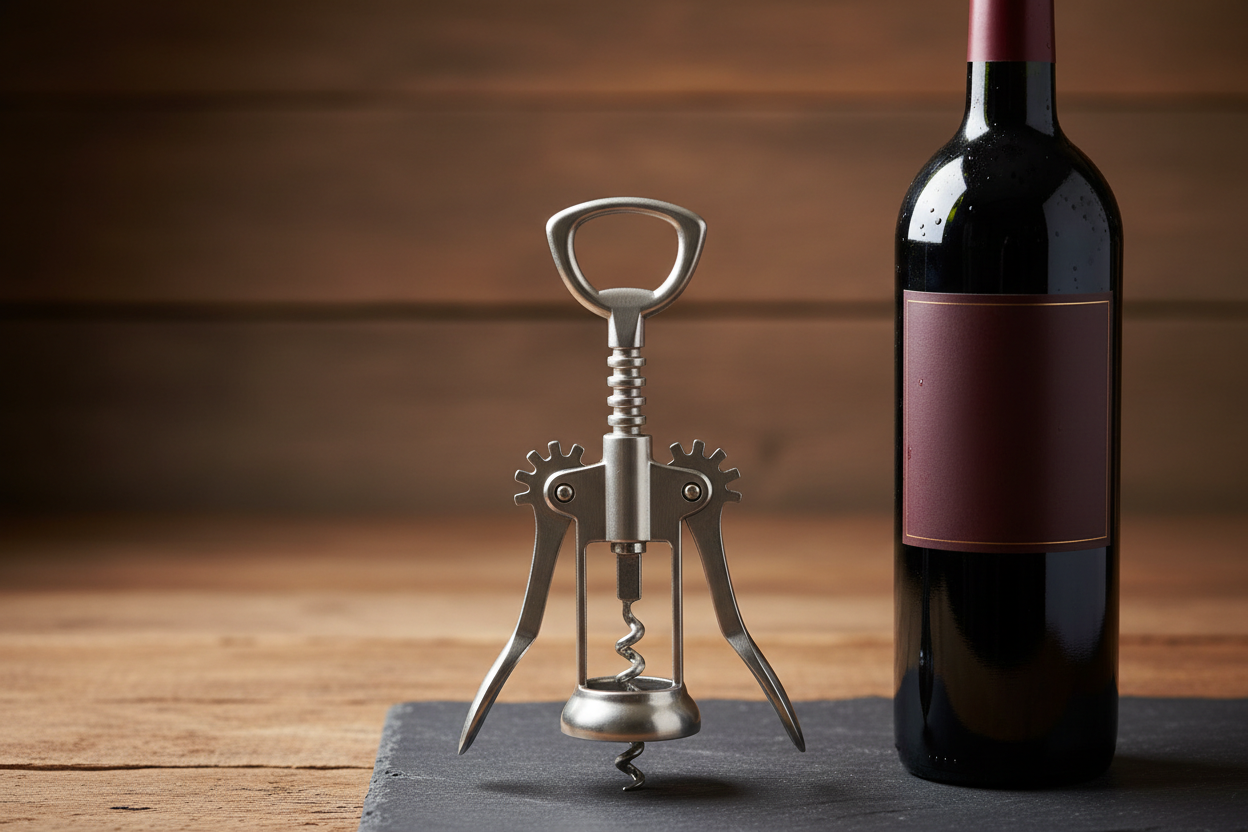
De Gaulle had this instantly recognizable gesture: both arms in a V-shape, slightly inclined upwards. The tool, in its open position, does exactly the same thing. A head (the metal or wooden handle), two raised fins, a bell at the bottom that fits snugly around the neck of the bottle.
This nickname is 100% French. Abroad, it's simply called the winged corkscrew or the butterfly corkscrew . In France, it's the Charles de Gaulle.

The different models
There are about ten main categories. Here are the most common ones, with their strengths.
| Kind | Mechanism | Ideal for |
|---|---|---|
| Charles de Gaulle (with fins) | Double lever + rack | Daily use at home |
| Waiter/Cocktail (Sommelier) | Simple lever, support notch(s) on the collar | Professionals, bars, restaurants |
| Bilaminate | Two blades slipped between the cork and the neck | Old, weakened corks |
| Screw-pull | Bell and auger that rotates continuously | Maximum comfort, for the general public |
| Electric | Motor that automatically inserts and extracts the auger | People with little strength, frequent use |
| Air corkscrew | Needle injecting pressurized neutral air | Anecdotal, rarely used |
Full lock of hair or pigtail?
It's the smallest detail that makes all the difference. A solid corkscrew (screwed in like a wood screw) doesn't grip well and risks piercing the cork. A hollow helical corkscrew—sometimes called a "pig's tail" corkscrew—distributes pressure along the entire length of the cork. It's easier to drive in, less prone to breaking old, damaged corks, and really holds during extraction. On the De Gaulle cork, always check that the corkscrew is hollow in the center.
A minimum of five turns is needed for a secure hold in the cork. Less than that, and the wick won't grip properly and may come out without the cork.

Which one to choose?
The answer depends on two things: how often you open bottles, and whether you do it alone or in a service.
For home use
The De Gaulle remains unbeatable for home use. It requires no learning curve, adapts to any type of closure, and its integrated bottle opener also opens beers. Opt for zamak or stainless steel rather than plastic, which can give way on tightly closed caps.
Things to check before buying:
- Hollow helical drill bit : always, without exception
- Plasticized internal support : to prevent chipping the neck
- Metal fins : not rigid plastic that breaks
- Large bottle opener in the handle : useful every day
For professional use
The wooden corkscrew is a must-have. It's the ideal knife for serving: compact and quick, it fits in an apron pocket.
If you have weak hands or arthritis, the electric model is for you. In 10 seconds, the bottle is opened effortlessly. (For champagne, using a champagne corkscrew will allow you to open your bottle effortlessly.)

Make good use of the De Gaulle
The movement is simple. But two common mistakes damage the corks.
- Remove the capsule up to below the neck ring. Use a capsule cutter or the tip of a corkscrew.
- Center the tip of the wick on the center of the cork. Place the cloche on the neck, perfectly vertical.
- Screw in slowly . The fins will gradually rise. Stop when they are at their maximum travel — the drill bit is at the correct depth.
- Lower both wings simultaneously . The rack and pinion mechanism transforms this movement into an upward pull. The cork comes out effortlessly.
- Unscrew gently to release the cork from the wick. No sudden jerks.
"The classic mistake is to screw it in too quickly and go all the way through the cork. The screw then comes out on the wine side, and fragments fall into the bottle. Take the time to center and screw it in evenly."
— Benjamin Fournier, sommelier consultant
Maintenance and repair
A metal model can last for decades, provided it receives minimal maintenance.
Cleaning
Rinse with clean water after each use. Avoid using the dishwasher: the heat will deform the plastic seals, and detergents will damage untreated metal parts. Dry thoroughly before storing.
Arms that seize up
If the arms become stiff, a single drop of cooking oil on the shaft on each side is all it takes. Operate the tool a few times to spread it. That's all.
Twisted or rusty drill bit
A bent or rusty drill bit can't really be repaired. Just buy a new one. Zamak is still under €15. It's not the kind of tool you'd want to skimp on.

FAQ
Which one is best suited for everyday use?
The Charles de Gaulle double-armed bottle opener, without hesitation. Easy to use, robust, and requires no special effort. For those who open many bottles in a row, the professional bottle opener remains the gold standard.
How to choose a good twist?
Hollow helical, not solid — this is explained in detail in the Types section above. The other criterion to check is the number of turns. Five turns minimum. Below that, the wick won't grip well on tough corks.
What is the difference between a manual and an electric model?
Manual: you perform the action. Electric: a motor automatically inserts and extracts the corkscrew at the touch of a button. Convenient for people with limited hand strength, but less precise on old, fragile corks.
What is the connection with oenology?
This tool wouldn't exist without the cork—and this cork wouldn't exist without the glass bottle. These three inventions are linked. It's the cork, inserted flush into the neck of the bottle, that made it possible to properly preserve wine, age it, and transport it. Without it, there would be no modern winemaking.
How do you maintain a De Gaulle?
The maintenance section above covers all of this in detail. In short: clean water, no dishwasher, a drop of cooking oil if it seizes up. A treated zamak model can easily last 20 years.
Key takeaways
The De Gaulle is English by invention, Italian by patent, and French by nickname. Three countries, three inventors, 50 years of evolution to arrive at the model we know. Always choose a metal model with a hollow helical worm. The rest is a matter of taste.
Benjamin Fournier
Wine merchant and sommelier-consultant, University of Wine of Suze-la-Rousse
Five years as a wine merchant, hundreds of bottles opened with all sorts of bottle openers. Suffice it to say, I have a pretty firm opinion on the matter of the wick.