Air-powered corkscrew: Our opinion
Operation, advantages, honest limitations, and a comparison of the best models. A guide for lemonade makers.
But it's not suitable for every profile or every earplug. This guide explains how it works, where it excels, and where its limitations lie—before you buy.
How does a compressed air corkscrew work?
No spiral, no lever. Air does all the work. Understanding the mechanism means understanding why it excels on some corks and fails on others.
The Principle of Pneumatic Pressure
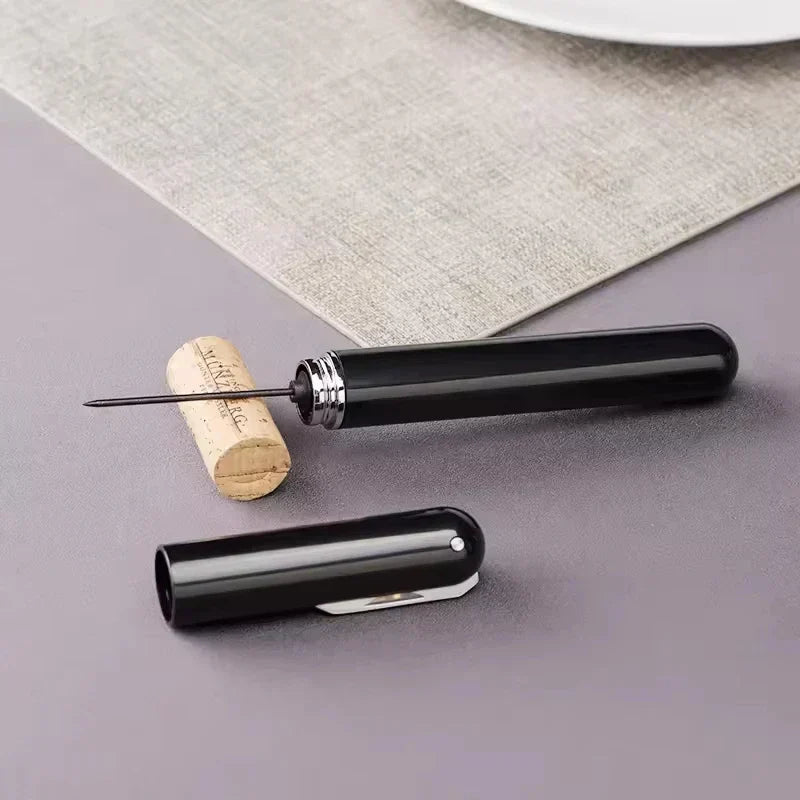
The air corkscrew works like a hollow syringe. You insert the stainless steel needle into the center of the cork until it goes all the way through. Then you pump.
Each pump injects ambient air into the bottle. The pressure builds between the wine and the cork. And the cork pops out, pushed by this pneumatic force, intact. It's the opposite of a wooden corkscrew, which requires brute force.
What's Really Happening in the Bottle
The mechanism is simple, but the needle must pass completely through the cork. If it stops halfway, no air enters and nothing moves. This is the most common mistake beginners make.
A standard cork comes out in 4 to 7 pumps. An old, compact cork: 7 to 10. Beyond that, there's no point in trying. The cork is probably porous.

The Real Advantages of the Compressed Air Corkscrew
Three areas where it truly surpasses other methods. No marketing hype: concrete benefits, in situations where they really matter.
The Spring Cap Intact
A well-used corkscrew won't break the corks. But a beginner who forces it, an old or poor-quality cork: crumbling is guaranteed, with pieces ending up in the wine.
The air corkscrew bypasses this problem. The cork isn't pulled or twisted. It comes out whole, with just a virtually invisible needle hole. Useful for collectors, practical for anyone opening a good bottle.
Ideal for old, fragile corks
With older vintages—say, over 15 years old—the cork ages, dries out, and becomes brittle. Even a skilled corkscrew can crumble it. The air-operated corkscrew exerts no twisting or pulling. The air does the work.
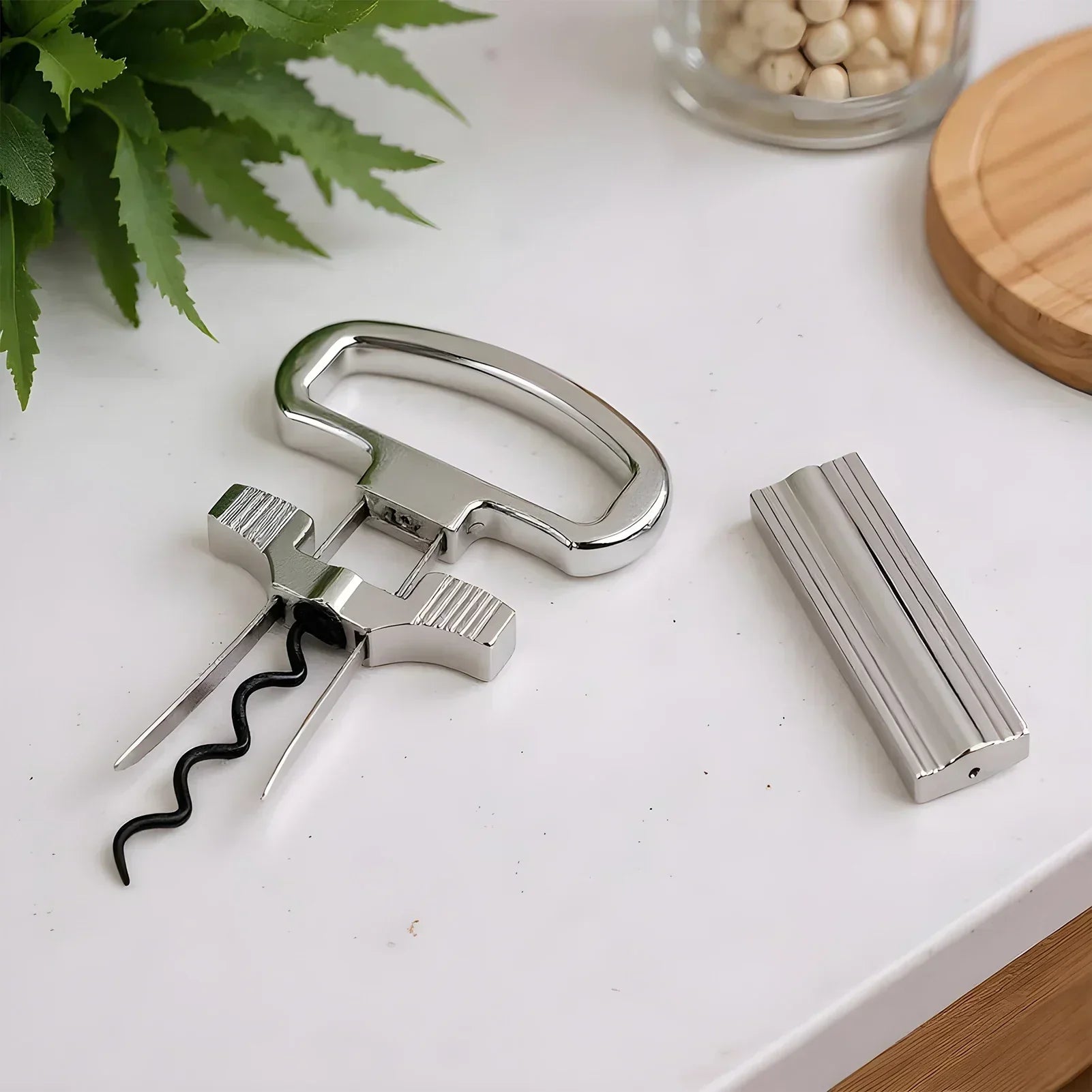
For lovers of old bottles, this is a tool to have in addition to the bi-blade corkscrew — the other reference on this type of cork.
Speed and Accessibility
5 to 10 seconds, no strength, no technique required. Anyone can use it without risk of damaging the bottle. For people with joint pain or limited hand strength, it's often the best choice on the market.

Honest Boundaries — What Other Articles Don't Say
Four real limitations that most guides overlook. Knowing them before buying avoids disappointment.
The Needle: The Product's Weak Point
On Amazon, the most frequent negative feedback is the same everywhere: the needle breaks . On entry-level ABS models, it's too thin and doesn't handle compact bottle caps well. One wrong move, a bottle not held properly, and it bends or breaks.
Avoid models under €15 on marketplaces. A steel body with a good diameter needle, between €25 and €35: that's the minimum for it to last.
Porous Plugs: The Physical Limit of the System
If the stopper is porous—degraded cork, cheap agglomerate—air escapes around the needle instead of accumulating under the stopper. You pump, but nothing moves. This isn't a product defect; it's a physical limitation of the design.
For this type of cork, go straight to the double-bladed corkscrew.
Prohibited on Champagne and Sparkling Wines
Absolute rule. Champagne, crémant, sparkling natural wine: never use an air corkscrew. The bottle is already pressurized. Adding compressed air inside is dangerous.
For champagne, remove the wire cage by hand and pop the cork while holding it firmly. If you don't have enough strength, you can still use a champagne corkscrew to help you.
Does injected air micro-oxidize wine?
The question that other content avoids. Here it is.
Yes, you're injecting ambient air into the bottle, which is a micro-dose of oxygen. For a wine drunk immediately, the effect is negligible—or even slightly beneficial for a wine that needs aeration. But if you recork the bottle to keep it for two or three days, this micro-oxidation can accelerate its aging.
After opening, use a vacuum pump. This is good practice regardless of the opening method.

How to Choose Your Air-Powered Corkscrew? 2026 Comparison
Three criteria to consider before choosing: the body material, the needle quality, and the budget depending on the intended use. A comparison chart and a straightforward recommendation for each profile.
Body Material: ABS or Stainless Steel?
ABS plastic models are lightweight and inexpensive (€10-20), but they don't withstand impacts or tight seals well. Stainless steel versions are stronger and more reliable over time. If you plan to use it regularly, choose the steel one.
The Needle: Diameter and Strength
This is the component that fails first on inferior models. A needle that's too thin bends on a compact stopper. Check that the manufacturer specifies the material (304 or 316 stainless steel). On good models, a rigid plastic sleeve guides the needle and prevents it from going in crooked.
Best Air-Powered Corkscrews in 2026
| Model | Material | Price | Strengths | Weak points |
|---|---|---|---|---|
| Corky (Switzerland) | Steel + plastic | €35-40 | Sturdy needle, meticulous finish, made in Switzerland | Some feedback on very dry corks |
| Elegear Air | High-quality ABS | 15-20 € | Lightweight, portable, good value for money | Less durable on compact caps |
| Laguiole Gift Set | Steel + resin | 40-55 € | Complete set, beautifully presented as a gift. | Medium-quality corkscrew only |
| Generic steel model | Stainless steel | €20-28 | Solid, simple, good needle | Basic design, no box |
Our recommendation based on your profile:
If you're a beginner or have limited hand strength, get the Elegear Air for €15-20. No need to spend more to start.
If you have good bottles and want to protect your corks, the Corky is worth its €35-40 price tag. It's the only model in this comparison designed specifically for that purpose.
Looking for a gift? Consider the Laguiole gift set, priced at €40-55. The corkscrew alone is just okay, but the presentation makes all the difference when you open the package.
Maintenance and Cleaning
After each use, wipe the needle with a damp cloth to remove any cork or wine residue. Do not leave it soaking: moisture corrodes the base of the needle, where it is most fragile.
Store it with the protective cap on the needle. If the model does not have one, a cork stopper is sufficient to protect the point.

Air Corkscrew vs. Corkscrew: Which to Choose?
The answer depends on the context. For everyday or professional use, the bottle opener is the better choice. For older bottles or beginners, the air-operated corkscrew is more suitable.
For Everyday Use at the Table
The professional corkscrew wins. Faster once mastered, universal, no consumables. It's the go-to corkscrew for professionals and regular enthusiasts.
For Restaurant Service (CHR)
The air-operated corkscrew is not suitable for restaurants. It's too slow compared to a skilled waiter's corkscrew, and it's not suitable for the common, less durable corks found in entry-level wines. In the hospitality industry, the waiter's corkscrew remains the standard.
For a Wine Cellar and Old Bottles
The air corkscrew deserves its place here. As a complement to the bi-blade corkscrew, it offers a gentler approach to old, still-intact corks. Having both in your cellar is a good strategy.

Who is it really made for?
Three typical profiles. Only one is not recommended.
Profile 1: The Beginner or the Person with Little Strength
Ideal for use. No technique, no effort. A €20-30 model is sufficient.
Profile 2: The Amateur Who Opens Old Bottles
Choose a sturdy model with a reinforced needle, between €30 and €45. It's not a suitable complement to a bi-blade; it's not a replacement for one.
Profile 3: To be avoided if…
You regularly open champagne or sparkling wines. You run a restaurant or wine bar. You're looking for a single corkscrew to do everything — the waiter will be more useful.

Our Opinion + What Buyers Are Saying
An expert opinion followed by feedback from real buyers collected on Amazon.fr and CouteauxDuChef.com.
It's a very good tool. Not universal, not meant to replace a lemonade maker, but within its category it does exactly what is expected of it.
What's most convincing is the reaction of people who aren't expecting it. At a party, someone inserts the needle, pumps two or three times, and the cork pops out by itself. Everyone wants to try. And everyone succeeds on the first try, without any explanation. That's what's so impressive.
I highly recommend it for home use, for evenings out, or as a gift. Go for the steel model and you won't be disappointed.
Positive Reviews
"It's truly the simplest and most effective one I've ever used. The people I've given it to are delighted with it."
— Monique G., verified buyer, CouteauxDuChef.com
"You don't need to be strong. You stick the pick into the cork and pump twice. The cork comes out by itself."
— Verified buyer, Amazon.fr
"Opens 90 out of 100 bottles effortlessly and without cork deposits in the wine."
— Verified buyer, Amazon.fr
Negative Reviews
"Some caps have a minor air leakage issue. The quality is decent but doesn't inspire confidence in its durability."
— Verified buyer, Amazon.fr
"Neither works despite numerous attempts."
— Jacqueline T., verified buyer, Interieur-Jour.fr
These reviews confirm what we say in this article: on a standard cork in good condition, the air corkscrew works very well. On a porous or damaged cork, it shows its limitations. And on lower-end models, the needle remains the weak point.

Gift Idea: Give a Compressed Air Corkscrew
A wine lover almost always has a bottle opener at home. Rarely an air-powered corkscrew. It's the gift that surprises. Discover our selection of compressed air corkscrews.
Which Model According to the Budget
- Under €25 : a sturdy ABS model. Ideal for someone new to the tool.
- €25-40 : a steel model, to be paired with a bottle for a coordinated gift set
- €40 and up : a complete set with foil cutter and vacuum pump. For a discerning enthusiast or a special birthday.
Two tulip glasses , a good bottle of wine, and a proper air corkscrew: a complete gift, zero waste. If you're giving it on its own, include a short note explaining how to use it. People like to understand what they're getting.

FAQ
Does the compressed air corkscrew work on all corks?
It works on natural and synthetic corks. But never on a bottle of champagne or sparkling wine: the internal pressure inside the bottle makes the operation dangerous.
How many pumps does it take to uncork a bottle?
Four to seven pumps are usually enough. For old or very compact corks, count on seven to ten. If the cork doesn't budge after ten attempts, it's probably porous: switch to a double-bladed corkscrew.
Does injecting air into the bottle alter the aromas of the wine?
Injecting ambient air introduces a micro-dose of oxygen into the bottle. For wine consumed immediately, the effect is negligible. For a bottle recorked several days prior, use a vacuum pump after opening.
What is the difference between an air corkscrew and an electric corkscrew?
The electric corkscrew screws and lifts the cork mechanically. Faster, it's suitable for all corks, even the hardest. The air corkscrew is more compact, doesn't require a battery, and is gentler on the cork. However, it's not suitable for porous corks or sparkling wines.
What should I do if the blockage doesn't come out despite several pumping attempts?
Check that the needle goes all the way through the cork—it should protrude slightly inside. If air escapes around the needle, the cork is too porous. Use a double-bladed corkscrew or a traditional corkscrew.
Key takeaways
The air-powered corkscrew is an excellent tool in its category. It doesn't replace a corkscrew, but for old, fragile corks and for those with weak hands, nothing works better. Choose a steel model, avoid those under €15, and never use it near a bottle of champagne. Otherwise, it's five seconds and the cork pops out.
Have you ever tried an air corkscrew? Many readers have told us they were surprised by how easy it is to use. Share your experience in the comments—the best feedback will enrich this guide.
Benjamin Fournier
Wine merchant and sommelier-consultant, University of Wine of Suze-la-Rousse
Read also
Everything you need to know about the lemonade seller
History, use and maintenance of the sommelier's corkscrew.
What type of glass should I use to drink champagne?
Flute, tulip or coupe: the sommelier's guide to choosing.