Naked sake glass, original
Where do sake glasses with a nude image at the bottom really come from, why aren't they Japanese, and what are the true tasting vessels? A Lemonade Guide
In this article, we debunk the myth, explain the technique, and show you what Japanese sake containers really are.
An American invention, not Asian
These cheeky containers come from the United States. They are neither Japanese nor Chinese in the traditional sense.
The Chinese diaspora created them to amuse tourists in their restaurants. In Japan, this type of object is impossible: the representation of genitalia is prohibited by law. No bar, izakaya, or shop in Tokyo sells them.
The drink served in these cups is not sake. It's Mei Kwei Lu Chew, a strong Chinese sorghum liquor unrelated to rice fermentation. Authentic sake glasses have nothing to do with these restaurant items.
In Japan, there are indeed Kutani porcelain pieces decorated with shunga—traditional erotic prints. But these are collector's items, reserved for art enthusiasts. They have nothing to do with the cheap ware you find in the neighborhood.

The Technique Behind the Image
It's a lithophane. When dry, the image is invisible. Fill the glass: it appears.
A convex lens is inserted into the bottom of the container. When dry, the curved surface disperses the light: the image remains invisible.
Pour in the liquid. It cancels out the effect of the lens and the image appears, clear, as long as the glass is full.
The drink is empty. The image disappears.

What Nihonshu Really Is
Nihonshu is made like wine. Terroir, water, rice variety, polishing ratio. Western sommeliers are beginning to understand this.
Breweries, the kura , work with the same obsessions as a winemaker: the vintage, the minerality, the balance between acidity and umami.
A junmai daiginjo—rice polished to over 50%—develops aromas reminiscent of a white Burgundy. Floral, taut, with a long finish. Serve between 8 and 12°C in a thin-stemmed glass. In contrast, a kimoto brewed using 17th-century methods yields something darker, almost umami, comparable to an aged Meursault.
This is not a digestif drink. It is opened at the table, with oysters, raw fish, and aged cheeses.
The sorghum alcohol served in Asian restaurants in France has nothing to do with any of this.

The Real Tasting Vessels
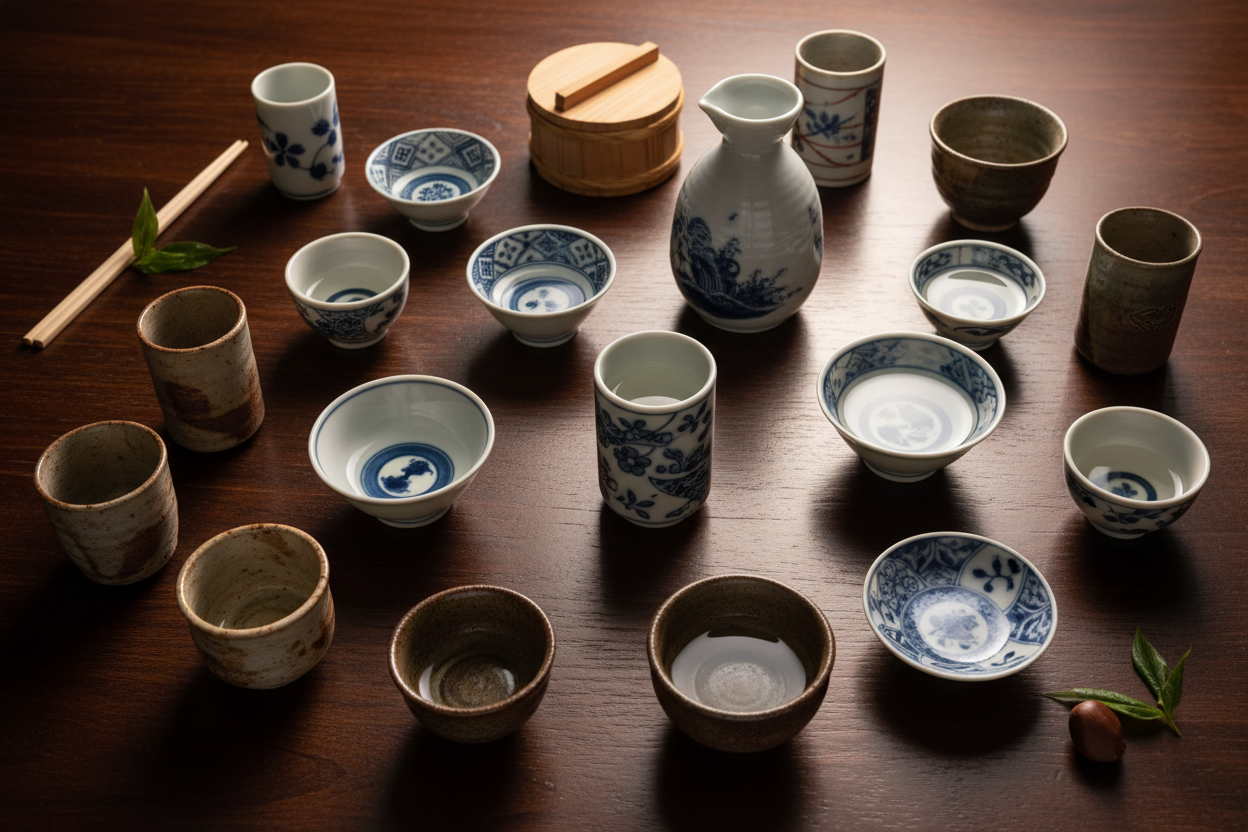
Nihonshu is drunk in very different forms. Each container has its place and its moment.
The Ochoko
The most common type. Small, round, without a foot, made of porcelain or terracotta. Capacity between 30 and 60 ml. It is used in izakayas to enjoy hot or cold drinks, sip by sip.
The Sakazuki
A flat, flared bowl, often made of fine porcelain. Reserved for ceremonies and weddings. Its open shape allows aromas to develop freely. It is as much a tableware object as a container.
The Guinomi
Similar to the ochoko, but larger. Available in stoneware, glazed ceramic, or lacquer. Perfect for relaxed gatherings with friends.
The Masu
A cube made of hinoki wood, that fragrant cypress. It was once used as a standard measure for rice. The wood adds its own notes to the beverage.
The Tokkuri
The carafe used for pouring into cups. It is heated in a water bath for serving hot wine. It is kept cold for fine wines.

How to Enjoy It the Japanese Way
You don't serve yourself: the host or a neighbor fills your cup. A simple gesture that completely changes the atmosphere of the meal.
You do the same for him. This gesture slows down the meal and forces you to pay attention to the other guests.
Regarding temperature: high-quality nihonshu is best served chilled or at room temperature, between 5 and 15°C. A fine crystal glass allows the drink's clarity to be fully appreciated. Serving it warm, around 50°C, is appropriate for regular vintages—not for junmai ginjo or daiginjo.
For the vessel: thick terracotta retains heat in winter. A thin crystal glass enhances the clarity of a chilled ginjo. A hinoki masu adds its own woody notes during festive meals. Each truly changes the experience.
Try an ochoko with a fresh junmai. The floral aromas change completely depending on the vessel. This is the best argument for no longer drinking nihonshu from just any cup.
FAQ
Are these glasses with a nude image Japanese?
No. They were invented in the United States by the Chinese diaspora. This type of container does not exist in the tradition of the archipelago.
Why do some sake glasses have cheeky designs?
It's an American tourist creation, with no connection to the culture of the archipelago. Explicit nudity is censored. These clips have been circulating in Western Asian restaurants since the 1950s and 60s, conveying a false image of nihonshu and its traditions.
What is the best container for tasting?
It depends on the style and the occasion. For a chilled premium vintage, a fine crystal glass. For a warm serving, a terracotta ochoko. For a festive meal, a hinoki masu adds a unique aromatic dimension.
What is the difference between ochoko and sakazuki?
The ochoko is cylindrical, for everyday use. The sakazuki is flat and flared, reserved for ceremonies. Both are held with two hands out of respect for the host.
Is nihonshu strong?
No. It has an alcohol content between 13 and 16%. It's enjoyed like a white wine, with floral, fruity, or umami aromas depending on the style and region. The sorghum alcohol served in Asian restaurants in France is much stronger and of a completely different nature.
Where can I find real Japanese sake glasses?
In specialty grocery stores or tableware shops. You can also browse our selection of sake glasses — ochoko, masu and tokkuri — available online.
Key takeaways
The cheeky sake glass isn't Japanese at all—it's an American invention of the Chinese diaspora, served with sorghum alcohol. In Japan, explicit nudity is censored by law. Lithophanes explain the image's appearance, but they have nothing to do with nihonshu (Japanese sake). The latter is enjoyed like a wine—with a specific terroir, vintage, and temperature—in an ochoko, sakazuki, guinomi, masu, or tokkuri. Each vessel truly transforms the experience.
Have you ever tasted real nihonshu? The difference compared to restaurant alcohol is striking. Share your experience in the comments—the best stories will enrich this guide.
Benjamin Fournier
Wine merchant and sommelier / Spirits, wines, beers and cocktails


Leave a comment
This site is protected by hCaptcha and the hCaptcha Privacy Policy and Terms of Service apply.