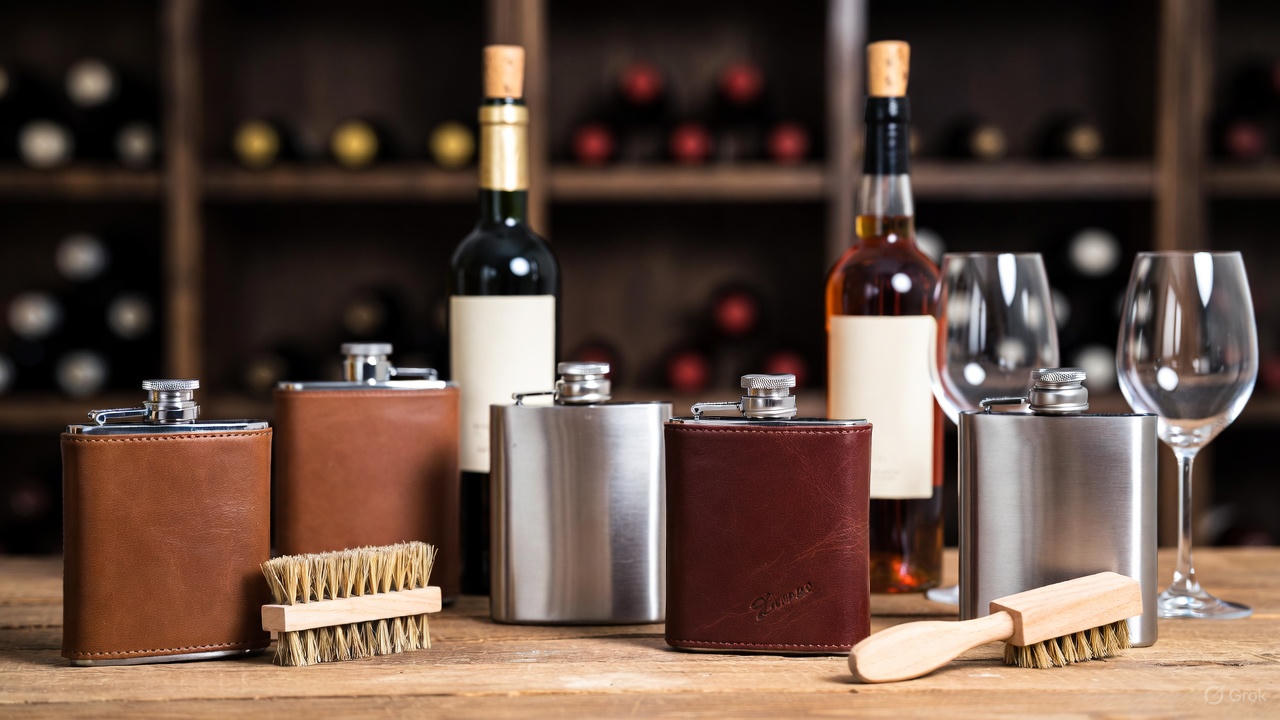
Choose your ideal flask according to your needs

Currently, 95% of flasks sold worldwide have stainless steel inner walls. This ensures that your container is suitable for holding alcohol without altering its taste. Now all you have to do is find a design you like and a size that suits your intended use.
Today, three types of exterior coating are available on the market: leather, which our Limonadier team considers the most elegant; stainless steel; and flexible plastic. Each style has its advantages, and for each of these materials, you can choose to personalize it if you wish to make it a unique gift.
In this guide, we will provide you with all the elements to ensure that your alcohol flask will be of good quality and will correspond to your choice of use and practice.
Why is stainless steel a must-have?

Composition and benefits
To understand why stainless steel is used in the inner walls of a flask, we need to look at the composition of these materials. It contains 18% chromium, 8% nickel, and molybdenum.
One of the indirect advantages of this steel alloy is that it makes cleaning your container much easier. The interior can be quickly cleaned with just water and a few drops of liquid soap, or directly in a dishwasher, just like a classic port glass . This is the feature that is appreciated by connoisseurs when giving it as a gift.

This combination of materials provides resistance to corrosion from high-proof spirits like 55% ABV whisky. This guarantees optimal preservation of your alcohol. The neutral taste of this alloy means there will be no interaction with your alcohol, resulting in no metallic taste like can occur in silver containers. While not quite as good as a tulip glass, it comes close!
The final advantage is its weight. This alloy is lightweight. A 240ml bottle weighs between 150 and 250 grams. You'll feel it in your pocket, but it won't be too heavy or uncomfortable.

Finishes and prices
The advantage of steel is that it's easily customizable; you can apply designs to it that make it unique. The most common is the Jack Daniel's motif, a must-have gift for a young whisky enthusiast. You can add laser engraving for a truly unique and personalized present.
It's good to know that one of the major disadvantages of steel is that every tiny scratch is visible. Care must be taken when handling and especially when storing it, as scratches will inevitably appear over time.
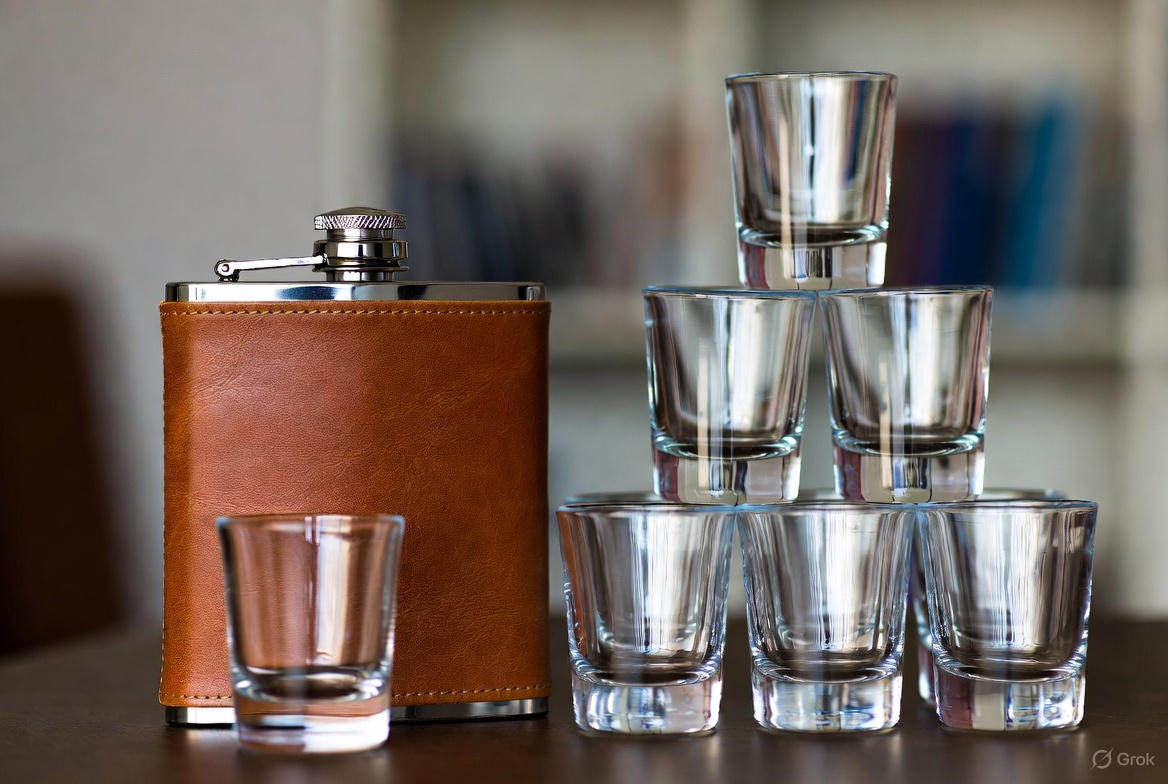
Prices start at €13 for a flask alone, without any accessories. A complete set, including a shot glass or several small shot glasses and the essential filling funnel, goes up to €40. Personalization will cost up to €15 extra. Shipping is free on every order at our Limonadier online store, so take advantage and save!
Why choose a leather covering and how to maintain it?

Construction, advantages, and price
Flasks with a leather covering still retain the stainless steel walls for the reasons of taste neutrality, durability and ease of cleaning, but a leather covering is added on top.
This covering is generally made of cowhide or synthetic leather, as these are the least expensive to buy while offering excellent durability. For practical reasons, it can be glued to the wall, saddle-stitched, or attached with small rivets. Visible stitching is a sign of elegance and quality. Rivets, on the other hand, are primarily for aesthetic purposes. Glue, of course, is the cheapest option.

At Limonadier, we make no secret of it: it's our favorite for the gentlemanly elegance it exudes. The feel is warm, not cold like steel. This makes it much more pleasant to use in winter. Over time, the leather changes color and develops a patina; each shade is often unique, which is what appeals to enthusiasts because it gives it character.
The price will be in the same range as steel. A single unit costs around €12, while complete models with all accessories (glass and funnel) will set you back €30. However, the hot stamping option on the coating will be more expensive.
Types of leather and finishes
| Leather type | Resistance | Patina | Average price | Lifetime |
|---|---|---|---|---|
| Full-grain cowhide | Good (standard) | Average (3-5 years) | 40-80€ | 8-12 years old |
| Buffalo | Excellent | Slow but noble | 70-120€ | 12-15 years old |
| Vegetable tanned | Average | Fast and marked | 60-150€ | 10-15 years old |
| PU synthetic leather | Weak | None | 25-45€ | 3-5 years |

Specific leather care
Note that it requires minimal cleaning. It should remain soft: a slightly damp cloth is sufficient to remove marks. Twice a year, apply a special cream (such as Saphir Gold Medal) to maintain its suppleness and prevent cracking. Remember to allow it to air dry completely to avoid the growth of mold.
What makes vintage flasks unique?

Period materials and manufacturing
Vintage flasks, meaning those made before 1980, were crafted from solid tin or lead (a tin-antimony-copper alloy). These materials gave them a characteristic heavy, cold feel, completely different from stainless steel. Sterling silver (925) was reserved for high-end models, often given as gifts at weddings or other important events.
Current use: decoration or function?
Limonadier recommends using it for decorative purposes only. You don't know the age or internal condition of the container, and it would be dangerous to use it. If the lining contains lead, in addition to the metallic taste that will spoil your drinks, you could experience health problems. We recommend that enthusiasts simply display their flasks. Some even appreciate in value on the art market!
What are the advantages of a mini flask and in what situations should it be used?

Available formats and capacities
Mini flasks come in three standard sizes. The 90ml size is equivalent to three shots of whisky. The 120ml size offers a good balance between discretion and sufficient capacity. And then there's the 150ml size, which is significantly more compact than a standard 240ml flask.
In terms of size, we're talking about pouches that are 10-12cm high, 6-7cm wide, and only 2cm thick. They literally slip anywhere: back jeans pocket, inside suit pocket, small handbag, travel pouch.
Ideal use cases and limitations

At Limonadier, we find this container size useful for whisky tastings in places where it would be difficult to do so with bottles, tulip glasses , etc. We reserve this size for small tastings of fine whiskies. We don't adhere strictly to this rule, but it's clear that sometimes 90ml is a bit limited for several people, and it can be frustrating not to have more. However, for one person, it's perfectly adequate.
Our second use case is for outdoor sports or activities with friends, such as hunting or skiing. It's nice to have just a small drink with friends outdoors. And this small format prevents us from overindulging and getting drunk.
And of course, the third use case is concerts and cinemas. These are places where we can't bring our own drinks in because it's prohibited so that people can buy the drinks sold inside. The dimensions of this size are a perfect choice because it's discreet and doesn't attract the attention of security guards. However, for this type of use, it can be a little frustrating not to have a larger container.
| Ability | Equivalent | Weight | Ideal situation | Average price |
|---|---|---|---|---|
| 90ml (3 oz) | 3 shots | 80-100g | Short, ultra-discreet evening | 15-30€ |
| 120ml (4 oz) | 4 shots | 95-115g | 3-4 hour event, travel | 18-35€ |
| 150ml (5 oz) | 5 shots | 110-130g | Festival, long outing | 20-40€ |
How do I personalize a flask and what engraving options are available?

Available marking techniques
Laser engraving is the most popular technique for stainless steel. The laser engraves into the metal, creating a permanent marking that will never fade. The result is crisp and flawless. Expect to pay €15-25 for a simple engraving.
Hot stamping will be used on the leather covering. A design heated onto a pin is pressed directly onto it. This creates a raised mark with a much deeper effect than laser marking. However, this option will cost you 30 euros.
Customization ideas
-
- Initials, monograms, and of course a date are the most classic choices. Simple, elegant, and above all, they make the flasks unique; collectors who receive them as gifts immediately make them their own.
- Personalized short messages are also quite popular at weddings.
- Logos and symbols open up more possibilities: company logo, family emblem, motorcycle symbol, hunting, fishing, however they will be more expensive to buy but they will make your gift truly unique.
Which material should you choose based on your priorities and budget?
| Type/Material | Sustainability | Interview | Taste | Weight (240ml) | Price | Ideal use |
|---|---|---|---|---|---|---|
| Standard stainless steel | 10/10 (>10 years) | Very easy | 100% neutral | 150-250g | €20-80 | Daily life, outdoor activities, beginners |
| Leather on stainless steel | 7/10 (8-12 years old) | AVERAGE | Neutral | 180-280g | 30-150€ | Gift, aesthetic, style |
| Vintage tin | 6/10 (fragile) | Delicate | Slight metallic taste | 280-400g | 150-2000€ | Collection, decoration |
| Mini stainless steel flask | 9/10 (>10 years) | Very easy | Neutral | 80-120g | 15-40€ | Discretion, travel, events |
| Personalized engraved | Based | Based | Based | Based | +€15-25 | Memorable gifts, weddings |
Conclusion of the guide

Given that the average price of flasks ranges from €10 to €40, price shouldn't be the deciding factor in your purchase. You should consider your actual needs and the required capacity. For hiking or sports like skiing, you'll definitely need flasks with a coating; otherwise, the contact of your hands with the steel won't be pleasant. Furthermore, since weight is an important factor, you'll likely opt for a mini flask or one with a maximum capacity of 200ml. Consider buying a set with glasses to share with friends.

If you're using it for travel or outdoor activities, you might want to consider larger flasks, such as 250ml. As for the material and size, the choice is yours. Vintage or modern style, the choice is yours. But again, don't forget to buy at least a funnel to make filling easier, otherwise you'll quickly regret it!
To learn more about alcohol flasks:
Find Limonadier's reports in the blog section. You might be particularly interested in:


Leave a comment
This site is protected by hCaptcha and the hCaptcha Privacy Policy and Terms of Service apply.