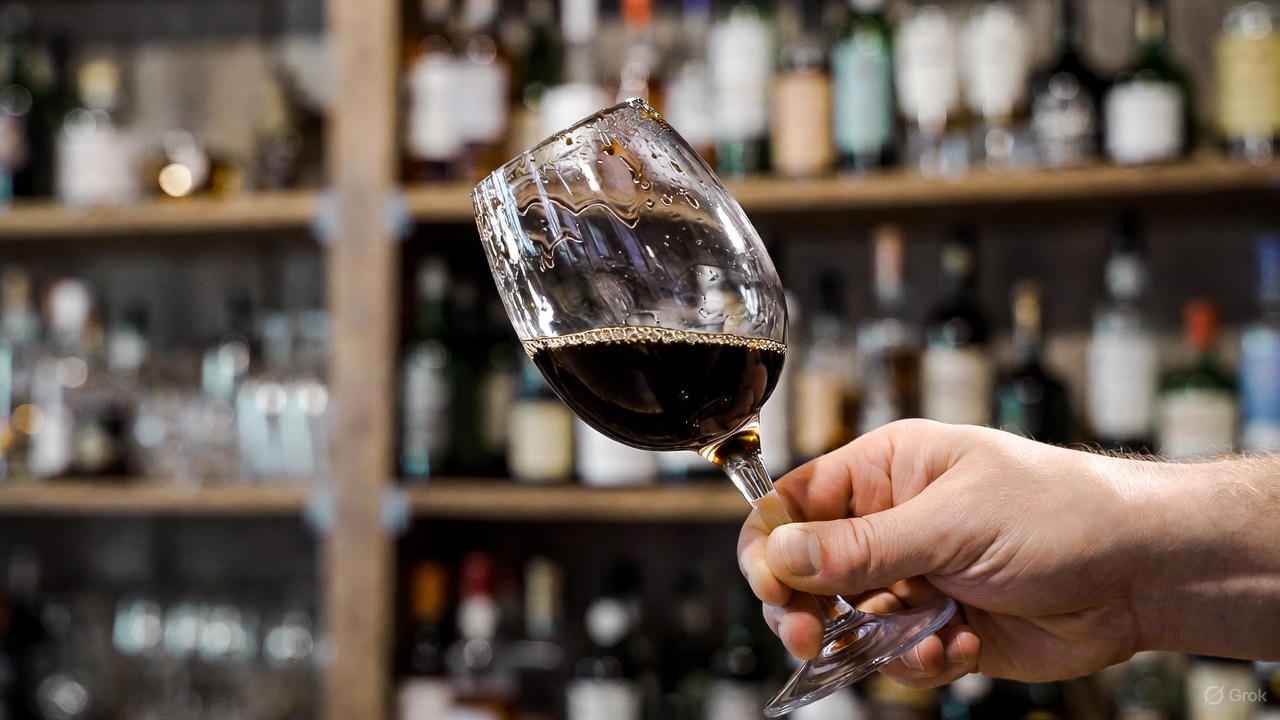
Every connoisseur knows that to truly appreciate the complexity and richness of a wine, one must observe its legs (or "tears"). However, a certain level of experience is necessary to fully uncover the secrets of a wine's legs and to fully enjoy a quality tasting. With this acquired experience, you will be able to discern the age, richness, grape variety, and balance of the Port wine you are about to taste (this also applies to other wines).
Why is the glass crucial for examining the color of port wine?

The color of your Port wines allows you to discover their story even before you bring the glasses to your mouth or nose. But to analyze your Port, you must first have a suitable set of glasses, including, of course, transparent ones.
Perfect transparency
Your wine tasting service should not contain any added coloring as a decorative effect to enhance its design or imitate a vintage style. This would alter your vision and interfere with your perception of how your wines behave.
This certainly wouldn't spoil your tasting experience, but your senses would be misled. After careful observation, you would expect to find certain aromas (fruit and spice for a Tawny, for example) and a certain concentration.
However, once in your mouth, the aromas and flavors will not be at all what you expected, even though your observation techniques were correct. On our online store , Limonadier, you can find a range of glassware suitable for this purpose at affordable prices.

No deformation
As we've seen, a clear port glass is essential. But not just any glass will do. If your glasses are clear but have a thick, raised pattern, it can create unwanted reflections that will mislead you during your analysis. The only exception to this rule is crystal glass. While these glasses are often more expensive, their thinness allows light to pass through without distortion.
A suitable shape: the tulip reveals all its secrets
As we have regularly explained in various blog posts, for Port tasting, Limonadier recommends using a tulip glass or a cognac glass . These shapes allow you to easily tilt the glass at a 45° angle to ensure a high-quality observation experience.
How to observe the color of port wine using the techniques of professionals?

Preparing the environment: creating optimal conditions
As with decanting whisky, light is important when observing Ports. Natural light or simply candlelight is preferable. There's no need to invest heavily in LED bulbs or anything like that. A little tip: if several people are tasting, try to avoid wearing overly colorful clothing; neutral colors are recommended.
Lens position: the angle that reveals everything
The 45° tilt: the fundamental movement
As with Cognac tasting, pour a small amount of alcohol into your glasses and hold them by the stem. Gently tilt the glass at a 45° angle until the liquid reaches the bottom of the glass. Hold the glass by the stem (never by the bowl, as your fingers will leave oily marks). Gently tilt it towards you until it reaches approximately a 45-degree angle. A helpful tip: once you've reached the correct angle, position your glass near a light source.
Observation sequence: the six systematic steps
Now that your Port wine is in a good position, here are the six techniques to apply:
- Overview (10 seconds): What is your first impression? Strong or light color intensity? Dominant color? This overall impression already guides your analysis.
- Clarity (15 seconds): Is the wine bright and crystalline? Do you see a slight haze? Any suspended particles? This observation reveals whether the port has been filtered and its state of preservation.
- Central color – the heart (20 seconds): What is the dominant color in the center of the glass, where the wine is thickest? Ruby red, garnet, mahogany, amber? This color indicates the type of port and its approximate age.
- The disc (20 seconds): Observe this sloping rim of the wine carefully. Does its color differ from the center? Is it wide or narrow? What is the transition between the center and the disc? We will return to this in detail later.
- The tears or legs (30 seconds): Gently swirl the glass. Observe the flow down the sides. Do the drops fall slowly? Are they thick? This reveals the alcohol and sugar content.
- Possible sediment (10 seconds): Look at the bottom of the glass. Do you see any particles or sediment? For unfiltered vintage wines, this is perfectly normal and even desirable after a few years in the bottle.
How to decipher the clarity and brilliance of port?
Clarity: the clarity that speaks of filtration

- If your Port is clear and bright: This means your wines are transparent. This is typical of Ruby and Tawny Ports, which have undergone several filtrations.
- If your wine is slightly hazy : This means it has a subtle opacity. This is typical of an unfiltered vintage, which should be over 5 years old. It's a sign of a rich array of aromas.
| Port wine type | Expected Clarity | Veil Acceptable | Interpretation |
|---|---|---|---|
| Ruby / Tawny standard | Total clarity | No | Complete filtration required |
| Filtered LBV | Total clarity | No | Ready to drink immediately |
| Unfiltered LBV | Light sail | Yes | Noble particles present |
| Vintage (< 10 years old) | Moderate sailing | Yes | Filing in normal formation |
| Vintage (> 15 years) | Large deposit | Yes | Decanting required |
Brilliance: the radiance that reveals youth
A wine is described as brilliant or even dazzling when it reflects light. In this case, it's very likely to be young and acidic. For example, this is typical of a rosé Port less than 10 years old.
A satiny sheen will give it softer, less harsh reflections. This is a sign of maturity. Tawny whiskies aged 20 years and older develop this fine, velvety sheen, a testament to their long aging in oak barrels.
Conversely, a matte appearance that has no reflections will be synonymous with oxidation or even a preservation defect.
What does the disc reveal about the age and concentration of the port?

What exactly is the disc?
When we talk about a "disc" in the description of a Port wine, we mean when your container is tilted at a 45° angle. An annular zone forms on this inclined surface at the rim, where the wine is thinnest. It is in this zone that you can analyze the true color of your Port without the concentrating effect found in a bottle.
This disc should be 5 to 10 millimeters wide. If it is too narrow, the color will not be visible.
Interpretation of the disc: the secrets revealed
A large, clear disc indicates youth and acidity, typical of Tawny whiskies less than 10 years old.
Conversely, if the nose is narrow and rather dark in color, this indicates a great richness of aromas. The color will be intense. Only an unfiltered Port will display this result.
Very rarely, an orange/brown/red color disc may appear. This is the result all professionals strive for. It's a sign that the aging process is in its final, mellow phase. The price of this Port will be as high as its age, meaning a minimum of 10 to 15 years.
The transition: gradual or abrupt
A color gradient may also be visible. This is a very positive sign. The technical notes will have a pleasant flavor. It will require considerable experience to decant this Port, as the aging process will have been very well managed. The price of this bottle will undoubtedly be high.
In the case of a sudden color change, there is no cause for concern; it is a sign of a very young wine that has not yet reached the aging stage.
What do tears reveal about the richness of port wine?

What are tears, scientifically speaking?
Everyone has noticed that when you swirl wine in glasses, a little always clings to the side and runs down slowly. This residue is called the "legs." Simply put, the higher the alcohol and sugar content of the wine, the more visible these legs will be.
This effect is called the Marangoni effect, named after the Portuguese physicist who studied it.
How to observe tears correctly
The techniques are simple but must be precise:
- Rotate the glass gently – no need to shake it violently. One or two turns are enough.
- Straighten the glass and immediately observe the inner wall.
- Mentally count the number of distinct "legs" that form.
- Observe their descent speed : fast (a few seconds) or slow (more than 10 seconds)?
- Note their thickness : thin as threads or thick as streams?
Interpretation of tears
If the legs are slow and rather thick, it's a sign of a high alcohol concentration. In the case of our Port wine, this means between 19 and 22% alcohol. This also indicates a high sugar content. For your information, Port wines can contain between 80 and 130 grams of sugar per liter. This sugar will make your wine heavier, which will slow down the legs.
Conversely, if the tears are rather quick and thin, it indicates a lower alcohol and sugar content. This is generally associated with dry white Ports, which contain between 18 and 19% alcohol with only 40 grams of sugar per liter. Less sugar means less resistance in the tears.
Rarely, when the aging process has been expertly managed, will you find (if you're willing to pay the price) a large number of "legs" (or "tears"). This signifies that your Ports possess an exceptionally wide range of aromas. This is generally the case with Tawny Ports.
Specific characteristics of port wine
A distinctive feature of Port, unlike whisky, is that there will always be visible sediment. With an alcohol content of around 19%, this will inevitably create "legs" in your glass. If this isn't the case, you're dealing with a counterfeit.
Only dry white ports will be an exception, with less visible tears, but they are still quite present. The sugar content is necessarily lower in a dry vintage.
What does the dress reveal about the complete identity of the port wine?

Identify the type of port
A brilliant ruby red with medium to strong intensity and pronounced legs? Without a doubt, you're looking at Ruby or LBV Port (although the latter are typically deeper and more concentrated). You should also detect notes of red fruit.
A mahogany/amber color that leans towards orange? Without a doubt, you're about to taste a vintage Tawny from the Douro Valley. This intensity will indicate the year of production; the paler and more golden it is, the older it is.
A garnet color? A rim that's turning orange? It must be a mature vintage. The signs of aging are starting to show around the edges. Typical of a white grape variety.
And in the latter case, a bright pink color never lies. You're dealing with a rosé Port that's still young and dry white, originating from a Douro Valley wine.
Estimate the approximate age
Just by looking at your Ports in a glass, you can estimate their age. For example, a strong color with purplish hues (Ruby) indicates that it will be very young, less than 5 years old. Even less than two years old if it tends towards purple.
Orange or brown? That's a direct sign that the Port is aging. In that case, it will be at least 10 to 15 years old.
Our advice: an amber disc on a red port = 15 years minimum .
Determine the breeding method

Oxidation (the Tawny method) creates these characteristic brown colors, this evolution towards amber and tawny hues. If you see these tones, you know the wine has spent years in barrels with gradual exposure to oxygen.
The reduction method (Vintage) preserves deep red colors much longer. A 15-year-old Vintage will still be a deep garnet, whereas a Tawny of the same age will already be a mahogany orange. This fundamental difference in method is immediately apparent in the glass.
Assess the state of conservation
A brilliant shine almost always indicates good preservation. The wine has not undergone excessive oxidation; it has been stored correctly.
A dull or matte appearance should raise a red flag. This could be a sign of faulty oxidation (different from the controlled oxidation of Tawny whiskies) or a problem with the cork. The nose and mouth will confirm or refute this suspicion.
A suspicious haze with abnormal opacity on a young, filtered port can indicate contamination, although this is rare. When in doubt, smell before tasting.
Our documentaries about Port wine
Want to learn more about Port wine tasting? Check out our series of reports on this topic!
- Everything you need to know about storing glasses in Porto
- Knowing the exact amount of Port to have in a glass
- Choosing the right glass for enjoying Port wines
- The story of the tulip glass and Port wine
- Aerating Port wine: decanting or letting it breathe?

.%20However,%20a%20certain%20level%20of%20experience%20is%20necessary%20to%20fully%20uncov...)
Leave a comment
This site is protected by hCaptcha and the hCaptcha Privacy Policy and Terms of Service apply.