Should you put water in your whisky?
Why distillers add water, which whiskies benefit most, which techniques to use, and when to refrain. A study by Limonadier
What Science Really Says
Water releases the aromas trapped by the alcohol content. This is proven, published, and it's what professionals do every day.
Whisky comes out of the cask at between 55 and 65% ABV. Before bottling, the distillery reduces it to around 40-46%. It's no secret: when you drink a Glenfiddich 12 at 40% ABV, the distiller has already done the work. Pouring a little into your whisky glass extends this process.
In 2017, two Swedish chemists, Björn Karlsson and Ran Friedman, published a study in Scientific Reports explaining the mechanism. Their discovery: guaiacol, a molecule responsible for smoky and peaty notes, has a greater affinity for ethanol than for water. When the alcohol content is high, the guaiacol remains trapped within the liquid. A tiny amount is enough to disrupt this balance. The guaiacol rises to the surface, where your palate can detect it. The aroma emerges.
This phenomenon isn't limited to guaiacol. High concentrations of ethanol form clusters of molecules that trap volatile compounds—esters, aldehydes, phenols. Just a few milliliters are enough to break up these clusters. That's why master blenders at Macallan, Highland Park, or Talisker systematically lengthen their samples when evaluating a cask. They don't do it out of personal preference. They do it because it's the only way to perceive the whisky's full spectrum of flavors.

Which Whiskies Benefit from Being Diluted?
The higher the alcohol content, the more a few drops make a difference. But the whisky's profile matters just as much as its alcohol content.
Cask strength: where it's almost mandatory
An Aberlour A'bunadh at 60%, a Glenfarclas 105 at 60%, or an Ardbeg Corryvreckan at 57.1%: at this alcohol level, the nose burns and the taste buds are overwhelmed. A touch is all it takes to transform the experience. The Corryvreckan reveals unexpected dark chocolate and candied lemon, and the mouthfeel shifts from burning hot to oily and enveloping. The A'bunadh opens with a solid block of sherry, giving way to a bouquet of red berries, cinnamon, and candied orange, with a finish that lingers for several seconds.
The peated wines of Islay: a guaranteed revelation
This is precisely what the Karlsson and Friedman study demonstrated: guaiacol rises to the surface when diluted. In a Lagavulin 16, a single drop is enough for the seaweed and iodine notes to blend with the smoke, and the palate gains roundness—the peaty character lingers without becoming overpowering. A Laphroaig 10 softens and reveals a more subtle medicinal character, with an almost creamy texture that is not perceived neat. A Caol Ila 12 opens with lime and sea salt notes that remain hidden neat, and the maritime finish is drawn out. The aromas change completely. Be careful though: adding too much will overwhelm the smoky profile. Proceed gradually.
Fruity Speyside wines: a gentle opening
A Glenfiddich 18 opens up beautifully with just two or three drops. The baked apple and oak notes expand, the finish lengthens, and it gains a roundness on the palate that wasn't present neat. A Glenlivet 15 French Oak reveals peach and almond notes that are barely perceptible without the addition—the texture becomes velvety, almost oily. Even a Balvenie 14 Caribbean Cask, already rich and full-bodied, gains in complexity: the rum and vanilla separate instead of blending together, and each sip tells a different story.
Whiskies of the world
This isn't just for Scots. A Nikka From The Barrel (51.4%) gains finesse with a splash of wine—the Japanese, in fact, have been practicing mizuwari (a diluted whisky) for centuries. A Wild Turkey Rare Breed (58.4%) becomes more approachable without losing its woody and spicy character. And in France, the cask strength whiskies from Rozelieures or the Warenghem distillery in Brittany deserve the same treatment.

How to Add Water Properly
First taste it neat, pour one drop at a time, and choose a neutral source at 18-20°C.
The five-step method, the one used by professionals:
- Taste it neat first. Pour your whisky, smell it, take a sip. This initial impression will serve as your reference.
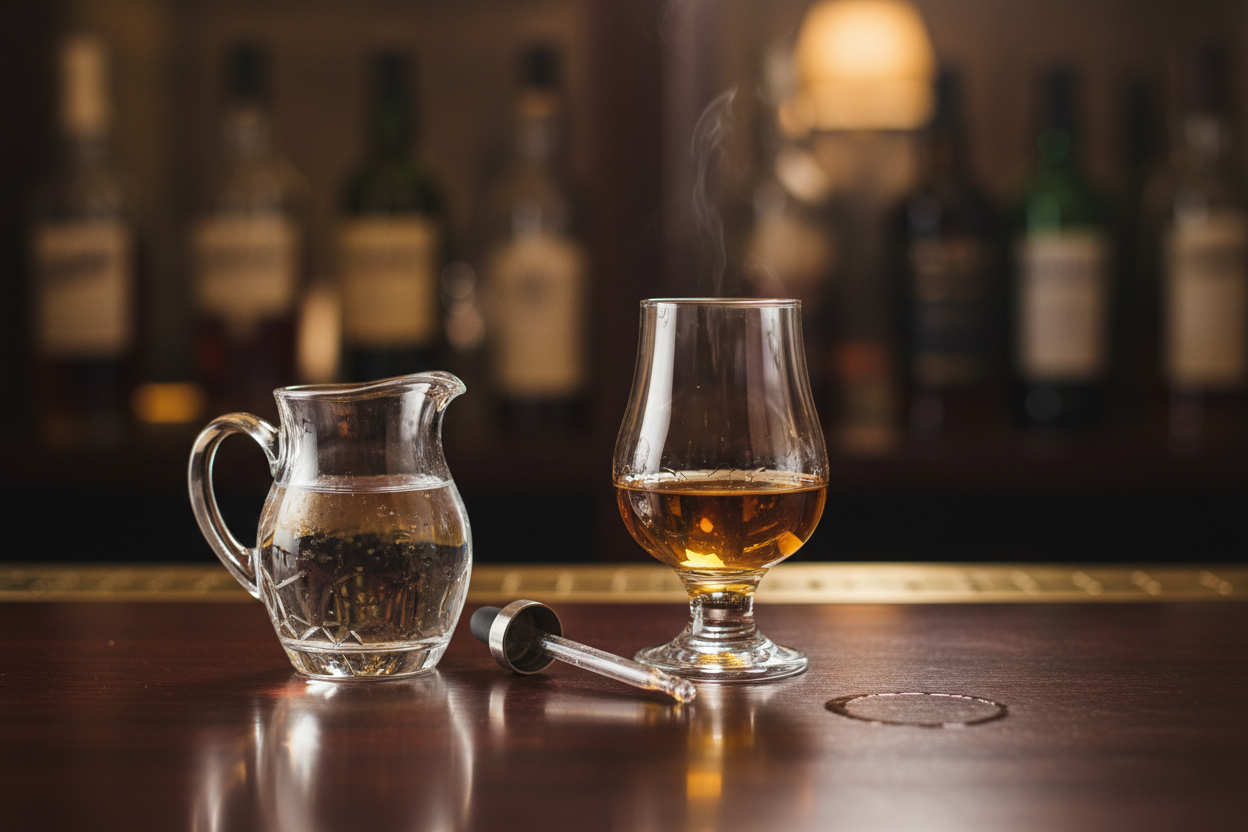
- Pour just one drop. A dropper pipette helps with dosing—it's the tool found in every distillery. A glass pipette costing a few euros works perfectly.
- Wait 20 seconds. Let the mixture develop. The aromatic molecules need a moment to rise to the surface.
- Smell it again, then taste it. Compare it to your reference. Note what has changed—texture, length, new aromas. It is this before/after comparison that gives the tasting its true value.
- Adjust as needed. You can always add more. The reverse is impossible.
Dosage guidelines: for a whisky between 40 and 43% ABV, one or two drops are sufficient. Above 46% ABV, use three to five. For a cask strength whisky of 55-60% ABV, some use up to a quarter of the volume. It's a matter of personal preference.
The glass matters too. A tulip-shaped glass like the Glencairn concentrates the aroma thanks to its narrow neck. After each drop added, you immediately perceive the change. With a wide tumbler, some of the effect is lost to the surrounding air.
Which water should I choose?
What you pay is just as important as the technique:
- Lightly mineralized spring water at room temperature (18-20°C). Volvic or Evian are very suitable.
- No tap water. Chlorine alters the bouquet, even in small quantities.
- Avoid highly mineralized water (Contrex, Hépar). Their own taste interferes with the whisky's profile.
- No sparkling water. The bubbles disrupt the aromatic balance.
In Scottish and Irish pubs, you're often served a small pitcher of still water next to your glass. Do the same at home.
When Not to Add Water
Water doesn't improve all bottles. Some are already at their equilibrium point as they are.
Three cases where it's best to leave the glass as is:
- The older vintages (18 years and older) are bottled at 40-43% ABV. A Glendronach 21 Parliament, a Dalmore 18, or a Tamdhu 15 have been meticulously crafted by the master blender to achieve their precise balance. Diluting them risks ruining this work rather than enhancing it. On the palate, they already offer a silky texture and a long finish—a few drops too many would make them flat.
- Light expressions are limited to 40% ABV. This is the minimum legal threshold. A Cardhu 12 or an Auchentoshan 12 loses its structure and roundness if diluted. The honey and grain become watery.
- The relaxed aperitif setting. A classic blend with friends on a summer evening? No need for a pipette or any formalities. Serve it however you like. Formalities only make sense when you want to explore a whisky, not when you're simply enjoying a good time over a bottle.
Water is a tool, not a requirement. The best test: always taste it neat first, and only add water if you feel the whisky has flavors to reveal that are being held back by the alcohol content.

Where to Start When You're a Beginner
You don't need to be an expert to learn how to properly taste a spirit. Just one whisky and one glass is enough.
If you're new to whisky tasting, start with an approachable single malt at 43-46% ABV—a Glenfiddich 12 or a Highland Park 12, for example. Pour it into a tulip glass, smell it, and take a sip. Note your first impressions: the flavors, the sensation of alcohol, the finish. Then pour a drop and repeat the exercise. The difference in aromas will often be evident from this first attempt.
The goal isn't to find the "right" answer. It's to learn to perceive how the alcohol content masks or reveals flavors and aromas. Every palate is different, and that's what makes spirits tasting so exciting: your taste is the only judge.

Water, Ice Cubes or Whiskey Stones: What's the Difference?
Water opens up the aromas. Ice cubes close them off by cooling too much. Stone ice cubes for whisky cool without altering the flavor — the best compromise when it's hot.
It's a common misconception: diluting and adding ice are not the same thing. A small amount of water at 18-20°C acts chemically on volatile molecules without altering the temperature of the glass. Ice does the opposite: it lowers the whisky to 10°C in a few minutes, which locks in the aroma, then melts and lengthens the flavor uncontrollably. It's fine with a blended whisky as an aperitif. But with a €50 bottle of single malt, it's a shame.
Steatite or stainless steel whisky stones offer a third option. Placed in the freezer for a few hours, they cool the glass by 4 to 6°C without altering the contents. The cold diffuses slowly. The serving temperature remains within the ideal range (16-20°C) for about fifteen minutes. The aroma remains intact.
The perfect combination for summer: whisky stones for chilling, and a few drops of spring water to open up the bouquet. You control the chilling and the opening separately. This is what connoisseurs do who want to enjoy their bottles without compromise, even when the temperature rises above 30°C.

Summary by Category
You have the bottle in hand and want a quick reference? This table summarizes the essentials:
| Category | Dosage (drops) | Advice |
|---|---|---|
| Cask strength (Aberlour A'bunadh, Glenfarclas 105) | 3 to 10 | Almost indispensable, it reveals hidden aromas. |
| Peated from Islay (Lagavulin, Laphroaig, Caol Ila) | 1 to 3 | Release the smoke, go slowly |
| Fruity Speyside (Glenfiddich, Glenlivet, Balvenie) | 2 to 4 | Amplifies the fruit and lengthens the finish |
| Bourbon (Wild Turkey, Maker's Mark, Woodford) | 1 to 3 | It tempers the wood and the sweetness, releases the spices |
| Japanese whiskey (Nikka From The Barrel, Yamazaki) | 2 to 5 | The tradition of mizuwari reveals the floral side |
| Aged single malt 18+ years old at 40-43% | None | Already balanced by the distiller, drink neat |
| Light blend at 40% (aperitif) | None | Already at its peak, adding more would make it bland. |
Frequently Asked Questions (FAQ)
Why put water in your whisky?
A few drops break up the clusters of ethanol molecules that trap the volatile compounds. The guaiacol and other aromas rise to the surface of the glass and become perceptible. This is proven by the Karlsson and Friedman study (2017). Distilleries do the same thing before bottling when they reduce the whisky's alcohol content from 60% to 40%.
How much water should you put in a whisky?
For a whisky at 40-43% ABV, one or two drops are enough. At 46-50%, use three to five. For a cask strength whisky above 55%, some use up to a quarter or a third of the volume. Always start with just one drop and adjust to taste.
What type of water should I choose to dilute my whisky?
A still, lightly mineralized spring water at 18-20°C. Volvic or Evian are excellent choices. Avoid tap water (chlorine), highly mineralized spring waters (Contrex, Hépar), and sparkling water. In Scottish pubs, a small pitcher of water is always served alongside the glass.
Do ice cubes replace water?
No, they are two different things. A stream of ice opens up the bouquet without changing the temperature of the glass. Ice cools below 10°C and locks in the aromas, then melts and lengthens uncontrollably. For chilling without altering the flavor, whisky stones are a better option.
How can I tell if I've added too much water?
If the whisky loses its structure on the palate and the aroma becomes flat, you've poured too much. The sensation of warmth should remain but be gentle, not aggressive. If it's too late, there's only one solution: pour another glass and start again, measuring more carefully.
Key takeaways
Adding a few milliliters to your whisky isn't heresy—it's chemistry. Distillers do it themselves, and the Karlsson & Friedman study proved why it works. Start with one, use a neutral source, and let your palate guide you. For cask strength and peated whiskies, it's almost essential. For older, already balanced expressions, keep them neat. And when it's warm, combine whisky stones for cooling with a splash of spring water to open up the bouquet —it's the best of both worlds.
Benjamin Fournier
Wine shop in Avignon / Spirits, wines, beers, and cocktails. Want to know what I think about ice stones? My review of ice stones is available here.


1 comment
Bonjour,
Limpide ces explications
Merci
Amicalement
Thierry Glorian
Leave a comment
This site is protected by hCaptcha and the hCaptcha Privacy Policy and Terms of Service apply.