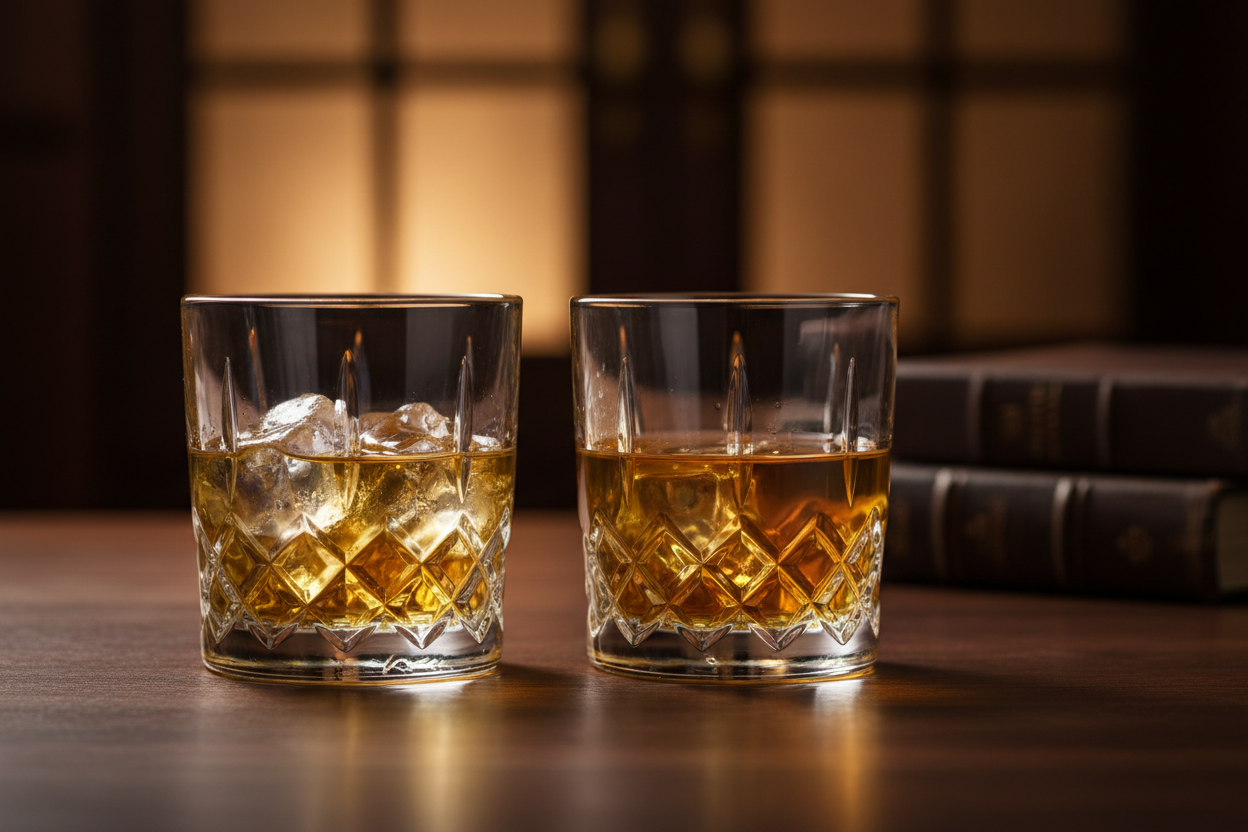
Whisky with or without ice?
Why pros never put ice in a Lagavulin, which whiskies accept it anyway, and what's the best alternative when it's 35°C outside? A Limonadier's Guide
At the end of the article, we invite you to share your own way of serving: we are curious to know how you do it at home.
What Ice Cubes Really Do to Whiskey
The main problem isn't the melting. It's the rapid cooling that closes the bouquet.
A standard ice cube can lower the temperature from 20°C to below 10°C in three to four moments. And that's where it all comes down to. Volatile compounds—esters, aldehydes, phenols—need at least 15°C to evaporate and reach your nose. Below that, they remain trapped in the liquid. The aroma subsides. It's not a matter of preference: it's physics.
Two centuries ago, Scots enjoyed their dram in homes at 14-16°C. The question didn't arise. Today, our homes, heated to 21-22°C, warm the bottle beyond the ideal temperature. The instinct to chill it is understandable. But it's a harsh method: it cools too quickly and continues to melt, diluting the whisky uncontrollably.
Then there's the quality of the meltwater. Ice cubes made with tap water introduce chlorine into your glass. With a €25 blend, no problem. With a €65 Glendronach 15, it's a shame. Adding a few drops of carefully selected water is a recognized tasting technique—but meltwater is anything but precise.

When It Works, When It Messes Up
Ice cubes aren't always the enemy. But they're not suitable for everyone.
When it ruins the tasting
On a pure Lagavulin 16, the smoke slowly settles in the mouth, followed by seaweed, iodine, and a thirty-second maritime aftertaste. Add two ice cubes: the smoke remains, but flat. The iodine disappears. The aftertaste is halved. You paid for a symphony, and all you hear is the bass drum.
The same is true of a Macallan 18 Sherry Oak. Neat, it offers aromas of dried fruit, cocoa, candied orange, and a thick, silky texture. With ice cubes, the sherry aromas recede, the cocoa disappears, and the texture becomes watery. A Glendronach 21 Parliament, a Dalmore 18, or a Balvenie 21 Portwood: the rule applies to all long-aged single malts bottled at 40-43% ABV. The master blender has already optimized the balance. Chilling it disrupts it.
The peated Islay peaty suffers particularly. A chilled Laphroaig 10 loses its medicinal character and iodine notes. An Ardbeg 10, so expressive neat with its hints of tar, lemon, and licorice, becomes completely flat. A Caol Ila 12 loses its saline finesse.
When it goes very well
A Johnnie Walker Black Label as an aperitif on a July evening? Two ice cubes, no problem. Blends are designed for stability. Their less complex profile holds up well to chilling. A Monkey Shoulder, a Ballantine's 12, or a Chivas 12 remains enjoyable with a touch of cold.
Americans too. A Wild Turkey 101 (50.5%) with a large ice cube is a tradition that makes sense: the alcohol content compensates for the length, and the hints of vanilla, caramel, and spice hold up well. A Maker's Mark, a Woodford Reserve, or a Buffalo Trace remain solid aperitifs. The oak and sweetness stand up well.
Cask strength bottlings can also handle it. An Aberlour A'bunadh at 60% or a Glenfarclas 105 can even be served with an ice cube: the alcohol content is so high that even when melted, the whisky only drops to 40-45%. However, this method is less precise than adding a few drops of spring water with a pipette.

Serve at the correct temperature
The ideal window temperature is between 16 and 20°C, depending on the profile. A few simple steps are all it takes.
If your bottle is stored in a room at 22-24°C in summer, the whisky will be a little too warm. More ethanol evaporates, and the alcoholic sensation masks the aromas. No need for an ice cube to fix this:
- Put the glass in the freezer. Place your empty whisky glass in the freezer ten minutes before serving. The chilled glass brings the whisky back to the right temperature. Nothing needs to be added.
- Keep the bottle chilled. Place it in the bottom of the refrigerator for twenty minutes. It will cool down to 16-18°C.
- The tulip glass . A Glencairn is held by the stem, not the bowl. Your fingers don't warm the whisky. With a wide tumbler, the warmth of your hand raises the alcohol content in moments.
Serving guidelines by profile: Islay peaty rums express themselves best between 17 and 19°C, fruity Speyside rums between 16 and 18°C, and American rums between 15 and 18°C. Below 15°C, the aromas begin to close up. Above 22°C, the ethanol dominates.

The Stones: The Smart Compromise
Stone ice cubes lower the temperature by 4 to 6°C. No stretching, no chlorine. It's the smartest option when you want something cold.
The principle: cubes of soapstone or stainless steel, placed in the freezer for a few hours, slowly release their coolness into the glass. No melting, no chlorine. The whisky drops from 22°C to 16-18°C in two to three minutes and remains at this temperature for a good fifteen minutes.
In a Highland Park 12, the result is clear. Neat at 22°C in summer, the alcohol content is a bit dominant and the honey takes a backseat. With two stones, the honey, heather, and hint of smoke return to the forefront. The texture remains smooth. You get the dram just as the distiller intended.
Soapstone or stainless steel? Soapstone is a natural, soft, and porous stone that doesn't impart any unwanted flavors. Stainless steel cools down a bit faster and is dishwasher safe. Both work. Use three to four stones per glass.
The winning combination for summer: stones to bring the temperature back into the right range, and a few drops of spring water if you want to enhance the aromas. You control the temperature and the opening separately, like a pro.

The Japanese Highball
In Japan, serving whisky with ice is an art. Not sacrilege. But the technique is nothing like what we do here.
The Japanese have been enjoying a highball—whisky topped with soda water over ice—since the 1950s. It's the most common way to drink whisky there. A Hibiki Harmony highball, with a large glass and sparkling water, is fresh, elegant, and perfectly balanced. The floral and fruity notes of the Hibiki hold up well because it was designed for this purpose.
The other tradition is the ice ball—a hand-carved sphere about 6 cm in diameter. Its small surface area means it melts much more slowly. A Nikka From The Barrel (51.4%) served with an ice ball stays focused for a long time. This is the opposite of the slow-melting, mass-produced cube.
Want to try a highball at home? Grab a Nikka Days or a Toki Suntory, a tall glass filled with ice, and top it off with sparkling water (1:3 ratio). It's a different kind of aperitif than a straight dram. No less legitimate, just another way to enjoy the moment. If you try it, let us know what you think.

Let it rest: Why it changes everything
Before even thinking about ice cubes or stones, let your whisky breathe. Five to ten minutes in the glass often transforms it more than any accessory.
The whisky has just spent years locked in a cask, then months in a sealed bottle. When you pour it, the lighter compounds escape first. Often raw ethanol and some harsh notes. If you taste it immediately, that's what you'll perceive.
Let the tulip-shaped whisky glass settle. The surface ethanol evaporates. Heavier compounds—fruit, spice, wood, smoke—take over. A Glenfiddich 15 Solera, tasted immediately and then after resting, doesn't give the same result. The raw honey of the beginning gives way to green apple, oak, and an unexpected hint of nutmeg.
That's why master blenders never rush. At Talisker, Springbank, or Glenmorangie, samples rest in the glass before each evaluation. Try it with your next bottle: serve two identical Glencairns, taste one immediately, let the other rest. The difference speaks for itself.

Mistakes That Ruin the Tasting
Even with the right glass and the right temperature, a few common habits can ruin whisky without us even realizing it.
Fill the glass to the brim. A single malt needs room for its aromas to circulate. Pour 3 to 4 cl into a Glencairn—your nose should be able to reach the rim of the glass without touching the whisky. If the liquid is too high, the flavors will mix with the raw alcohol, and you'll taste nothing but ethanol.
Enjoy it right after a coffee or a spicy dish. Your palate needs time to calm down before you can fully appreciate the aromas of a malt. Rinse your mouth with water and wait a moment. Tasting a Talisker 10 after an espresso is like listening to Debussy in a construction site.
Dilute a single malt with soda water. The bubbles burst the volatile compounds and disperse the bouquet. Soda water is suitable for a Japanese highball with a blend designed for it—not for a Glenfiddich 18 that you're trying to drink at a leisurely pace.
Judging a whisky by the taste of the first sip. The mouth isn't ready. The burn of the alcohol masks all the flavors. Swirl the sip, swallow, wait. It's from the second sip onward that the taste reveals itself—the fruit, the wood, the peat, everything arrives after the palate has acclimatized.

Your First Comparative Test
Nothing beats experience. Here's how to test it yourself in just one bottle of whisky .
Take a whisky you know well—a Glenfiddich 12, a Talisker 10, or a Highland Park 12, for example. Prepare three identical whisky glasses. Pour 3 cl into each.
Glass 1: Neat, with nothing added. Let it rest. Smell the aromas, then taste. Note what you perceive in your mouth: sweet, salty, bitter, fruity, smoky, or spicy flavors. This is your tasting reference.
Glass 2: Two ice cubes. Wait for the temperature to drop. Smell, taste. Compare to glass 1: which flavors have disappeared? Is the aroma as rich? Does the aftertaste last as long? You will understand precisely what the ice cubes do to the aromas.
Glass 3: Two whisky stones. Same wait, same tasting. This time, the temperature dropped without adding water. You should find more flavor than in glass 2. A little less intensity than glass 1.
This simple test teaches you more about your tastes than a year of reading. And it's the kind of experience we love to share—if you try it, tell us what you discovered about your whisky.

Summary by Category
The bottle is on the table, you hesitate. This chart summarizes the right approach:
| Category | Ice cream? | Degrees | Recommended method |
|---|---|---|---|
| Peated from Islay (Lagavulin, Laphroaig, Ardbeg) | ❌ No | 17-19°C | Pure, or perhaps a drop of water |
| Single malt 15+ years old at 40-43% | ❌ No | 18-20°C | Pure, with a 5-10 minute rest |
| Fruity Speyside (Glenfiddich, Glenlivet, Balvenie) | ⚠️ Stones | 16-18°C | Stones if needed, at a cost |
| Cask strength 55%+ (A'bunadh, Glenfarclas 105) | ✅ Possible | 16-20°C | An ice cube OR drops measured with a pipette |
| American (Wild Turkey, Maker's Mark, Woodford) | ✅ Yes | 15-18°C | Tradition on the rocks respected |
| Japanese (Hibiki, Nikka, Toki) | ✅ Ice ball | 12-18°C | Highball or ice ball |
| Aperitif blend (JW Black, Monkey Shoulder, Chivas) | ✅ Yes | 12-18°C | Ice cream, no problem |
FAQ
Do ice cubes mask the taste of whisky?
Yes, partly. Below 15°C, volatile compounds no longer evaporate, which reduces the aroma and nuances on the palate. In a complex single malt, the loss is significant. In a blend or an Americano, the impact is less pronounced because the profile is more robust.
How to choose between water and ice cubes?
Room-temperature spring water releases aromas without chilling them—it's a tool for exploration. Ice cubes both cool and lengthen the experience. If you want to perceive the nuances of a whisky, opt for drops. If you want a cool and relaxed aperitif, ice cubes do the trick.
Do whisky stones really work?
Yes. They lower the temperature by 4 to 6°C slowly. The effect is gentler than with traditional cubes. That's precisely the advantage: the whisky stays within the ideal temperature range. Use three to four stones per glass and place them in the freezer at least two hours beforehand.
Why let the whisky rest in the glass?
The surface ethanol evaporates during the first few minutes, allowing more complex compounds—fruit, spice, and wood—to emerge. Five to ten minutes of rest often changes the tasting experience more than any accessory.
Which glass should I choose to enjoy my drink without ice cubes?
A Glencairn tulip glass concentrates the aromas thanks to its narrow neck and is held by the stem to avoid warming the whisky. This is the model used in all Scottish distilleries. A wide tumbler is suitable for serving with ice cubes, but dissipates the aromas into the air.
Key takeaways
Ice cubes aren't forbidden—they're just not suited to certain whiskies. With a peated Islay or an old 40% single malt, chilling them closes off the bouquet and shortens the finish. With a blend, an Americano, or a cask strength whisky, they work well. The smartest alternative: whisky stones for chilling, combined with a few drops of spring water to open up the bouquet. And above all, let your glass rest for five minutes. It's free, and it often makes the biggest difference.
And you, how do you serve yours? Neat, with stones, or as a highball? We love discovering our readers' habits. Share your favorite method in the comments or on our social media—the best feedback will enrich this guide.
Benjamin Fournier
Wine shop in Avignon / Spirits, wines, beers and cocktails


Leave a comment
This site is protected by hCaptcha and the hCaptcha Privacy Policy and Terms of Service apply.