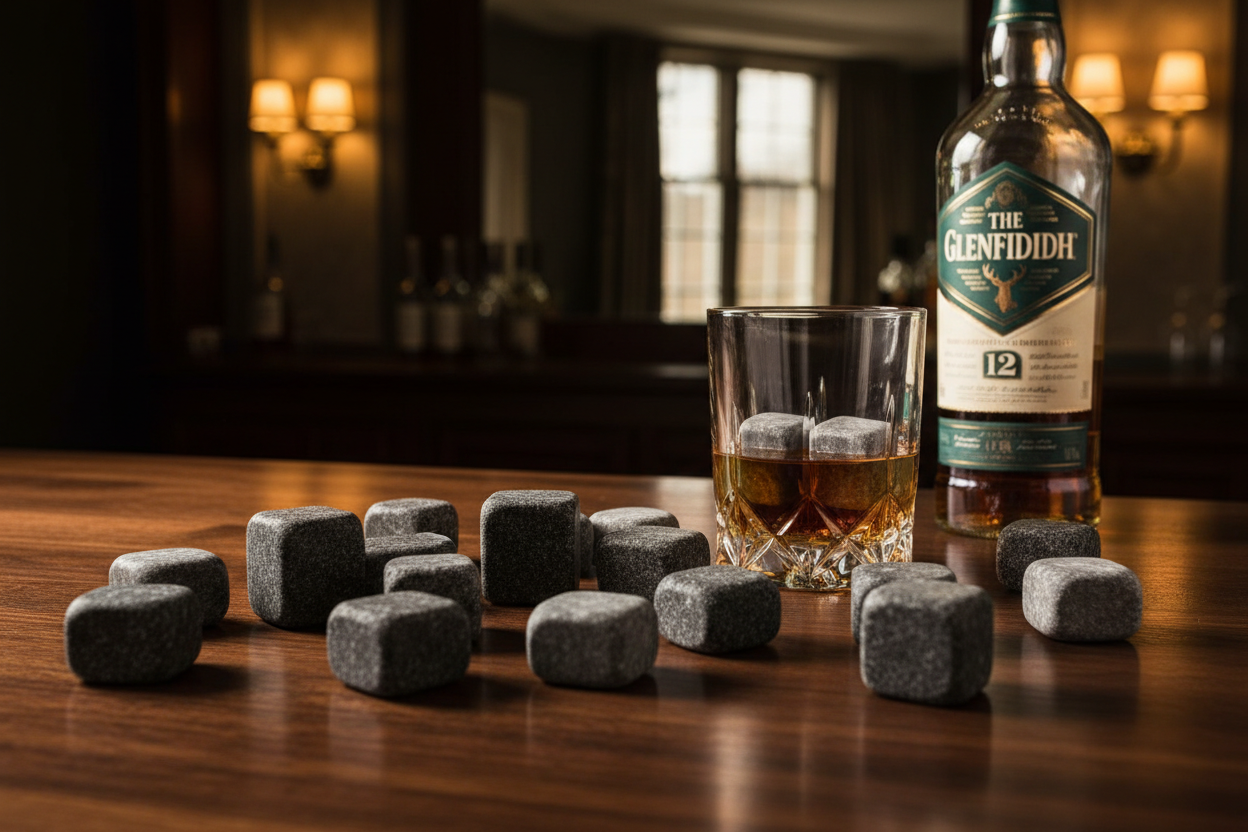
Stone ice cubes for whiskey: Reviews and buying guide
Comparison: granite and stainless steel. Tests with whiskies. Prices by range and effective alternatives for preserving your spirits without dilution. A study by Limonadier
What is a Whiskey Stone and How Does It Work?
Whiskey stones cool the temperature by 2-3°C without dilution, compared to 10-15°C with ice cubes. Stored at -18°C for 2-4 hours, they remain effective for 10-15 minutes. Granite (2.7 g/cm³) dominates the market due to its density and neutral flavor.
Operating principle
Whisky stones are cubes of natural stone designed to chill whisky without diluting it. The principle relies on the thermal capacity of the materials: stored at -18°C in the freezer for 2-4 hours , they reach a serving temperature of 6-8°C in the glass. This temperature allows the whisky to be chilled by 2-3°C, compared to 10-15°C with traditional ice cubes .
The physics is simple: the stone absorbs the heat from the whisky through thermal conduction. However, unlike ice cubes which maintain 0°C by melting, the stones warm up gradually. Their effectiveness lasts a maximum of 10-15 minutes , during which time the temperature gradually rises back to room temperature.

Materials used
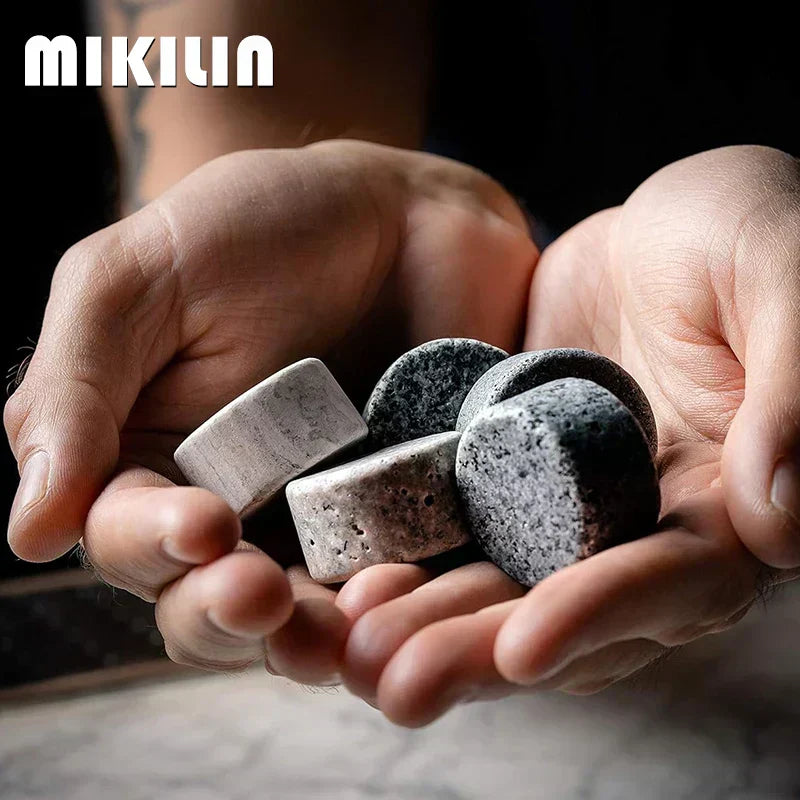
Granite dominates the market thanks to its high density (2.7 g/cm³) and neutral flavor. Soapstone, being softer, offers gentler cooling but is less durable. Stainless steel versions cool faster but can impart metallic notes, particularly noticeable with delicate whiskies.
The standard size of 2.5 cm³ represents a compromise between thermal efficiency and practicality. Larger stones cool better but take up too much space in a standard tasting glass.

Advantages and Disadvantages: Our Detailed Analysis
No dilution and reusability are its real advantages. However, the cooling effect remains limited (2-3°C) and temporary (10-15 min). The maintenance and 2-4 hour pre-freezing discourage spontaneous use.
Verified positive points
The main advantage remains undeniable: no dilution of the whisky . Tests show that ice cubes dilute whisky by 15-20% in 600 seconds, significantly altering the alcohol/water balance. The stones preserve this integrity, crucial for appreciating premium whiskies.
The aesthetic appeal is also significant: the stones add a sophisticated visual dimension, particularly appreciated during tastings among enthusiasts. This presentation partially justifies the €40-60 investment for a quality set .
Reusability is a long-term economic advantage. A well-maintained granite set lasts 3-5 years with regular use.
Actual limits
The cooling effect is limited and represents its main weakness. Measurements reveal a temperature drop of only 2-3°C , insufficient for enthusiasts seeking a truly chilled whisky. The short duration of the effect (900 seconds) necessitates repeating the process for a prolonged tasting experience.
Maintenance is cumbersome: careful washing after each use, complete drying to avoid limescale buildup, then freezing for 2-4 hours before use. This process discourages spontaneous use.

Impact on Taste: Tests with Distilleries
Tropical whiskies (Kavalan, Amrut) benefit from being slightly chilled. Scotch whiskies (Glenfiddich) lose some of their complexity. Optimal serving temperature: 18-21°C, rarely achieved with stones.
Tropical climate whiskies
Kavalan, a Taiwanese distillery, produces whiskies that respond positively to slight cooling. The tropical fruit notes (mango, pineapple) are better preserved at 18-19°C than at room temperature (22-24°C). This distillery, facing an annual evaporation rate of 15% compared to 2% in Scotland , produces concentrated whiskies that withstand this technique well.
Amrut, an Indian whisky, has an intense spicy profile that mellows with age. The cardamom and black pepper notes become less aggressive, revealing nuances of honey and dried fruit usually masked by the spicy intensity.

Temperate climate whiskies
Scotch whiskies, such as those from Glenfiddich, exhibit a noticeable reduction in aromas when exposed to stones. Notes of dried fruit and sweet spices lose 20-30% of their intensity at lower temperatures. Aromatic complexity is diminished.
Expert consensus establishes the optimal tasting temperature between 18-21°C for maximum aromatic expression, a temperature that stones rarely reach.
Comparison of Materials and Alternatives
Granite: -3°C for 15 minutes (€50-60). Soapstone: -2°C for 12 minutes. Stainless steel: -4°C, but may produce metallic notes. Recommended alternative: chilled carafe, effective for 30-45 minutes.
Natural stones vs. metals
Granite offers the best thermal capacity thanks to its high density. Tests show that a 3°C cooling effect is maintained for 15 minutes with quality granite stones. The price of €50-60 for a set of 6 stones is justified by their durability.
Steatite allows for gentler cooling ( -2°C, 12 minutes ). Stainless steel cools quickly ( -4°C ) but presents a risk of taste contamination, with metallic notes perceptible after 300 seconds of contact.
- Granite : -3°C, 15 min, €50-60/set, optimal taste neutrality
- Soapstone : -2°C, 12 min, €15-25/set, good value for money
- Stainless steel : -4°C, rapid cooling, €40-70/set, risk of metallic notes

Alternative methods
A chilled decanter is the most effective solution for consistent cooling. Stored at 4-6°C, it keeps whisky at the ideal temperature for 30-45 minutes . A pre-chilled glass, a professional technique, offers an elegant compromise: fifteen minutes in the refrigerator is enough to lower the serving temperature by 2-3°C.
Reference Brands
Whiskey Stones (€20-30) to start with, Teroforma (€50-70) for design, Glacier Rocks (€15-20) for the best value for money.
Whiskey Stones
This leading American brand offers soapstone sets between €20 and €30 . Their stones are perfectly resistant to repeated temperature variations. Whiskey Stones is suitable for beginners looking for a reliable option. Choose this brand for a risk-free first purchase.
Teroforma
Teroforma positions itself in the design segment with prices ranging from €50 to €70 . Their steel cubes offer original shapes and optimal cooling. This brand targets discerning enthusiasts who value aesthetics. Invest in Teroforma if you entertain frequently and pay attention to presentation.
Glacier Rocks
Glacier Rocks offers the best value for money between €15 and €20 . Their soapstones perform as well as more expensive brands. This brand is perfect for tight budgets without compromising on quality. Choose Glacier Rocks if you're starting out on a budget.

Maintenance and Durability
Wash with neutral soap after each use. Not dishwasher safe. Lifespan: 10-15 years with proper care. Store in the freezer for immediate use.
Always wash your stones in lukewarm water with mild soap after each use. Avoid using a dishwasher, as it can damage the natural stones over time. With proper care and normal use, they will last 10 to 15 years .
- After each use: warm water + neutral soap, dry immediately
- Storage: Keep in the freezer at all times for immediate use
- Avoid: dishwashers, abrasive products, boiling water
- Replace any cracked stone immediately (risk of splinters)
- Storage pouch recommended for protection against impacts
FAQ
How many stones should be used per glass?
Use 2 to 3 stones for a standard glass of up to 200ml . More stones don't significantly improve the perceived coldness but make the glass bulkier. Use 2 stones for tasting glasses and 3 for tumblers.
What is the price of a good set of stones?
Expect to pay €40-60 for a quality granite set with 6-9 stones. Budget versions at €10-20 use less effective materials. The investment is justified by their durability over 4-5 years.
Are whisky stones suitable for peaty whiskies?
Whisky stones are ideal for peaty whiskies because they cool without diluting, thus preserving the peaty and smoky aromas. They lower the temperature by 2 to 5°C , revealing aromatic complexity without masking the peaty notes. A peaty Islay like an Ardbeg or Laphroaig retains its phenolic notes intact. Use 2 to 3 stones per 4cl glass for optimal chilling.
Chilled decanter or whisky stones: which is the best solution?
The chilled decanter offers even and lasting cooling, keeping your whisky at the ideal temperature for 45 minutes . Whisky stones are less effective at cooling, lowering the temperature by only 5°C compared to 11°C for a decanter that has been pre-chilled for 4 hours in the freezer. The choice depends on your needs: a decanter for extended tastings, stones for a discreet and occasional chilling when serving individually.
How long do whisky stones last?
Whiskey stones maintain their cooling effect for approximately 15 minutes in your glass. They require a minimum of 4 hours of freezing to be effective and can chill your whisky by 2 to 5°C without dilution. Soapstone or granite stones retain their coldness longer than stainless steel ones. With proper care, they can last for several years without losing their thermal properties.
For more information on use and care, see: Ice Stone: Uses and Benefits
Key takeaways
Whisky stones are an attractive accessory due to their aesthetic appeal, but their effectiveness is limited. They offer only modest (2-3°C) and temporary (10-15 minutes) cooling , insufficient for serious connoisseurs. Premium whiskies lose their aromatic complexity with this technique. A chilled decanter or a pre-chilled glass is a better alternative for preserving the whisky's organoleptic qualities. Stones can be used as a presentation accessory for young blends or special occasions, but they cannot replace tasting at the optimal temperature of 18-21°C.
Benjamin Fournier
Wine shop in Avignon / Spirits, wines, beers and cocktails


Leave a comment
This site is protected by hCaptcha and the hCaptcha Privacy Policy and Terms of Service apply.